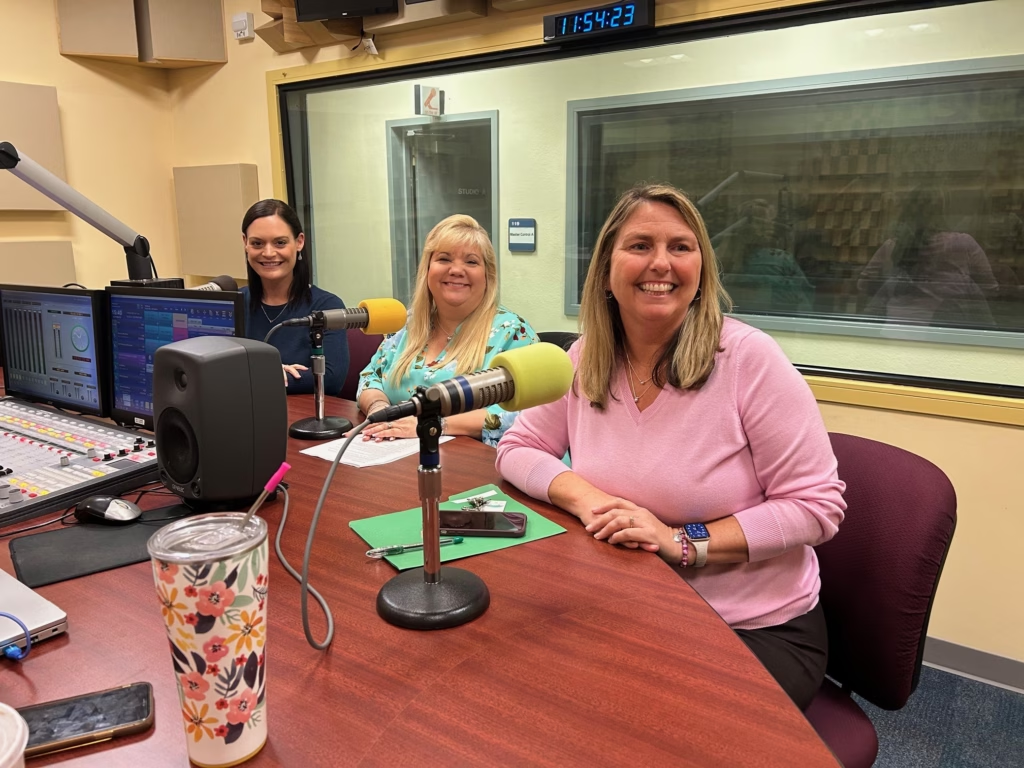
Listen to the Full Conversation: This blog post is based on an episode of River Talk on IRSC Public Media, hosted by Kathleen Walter. For the complete conversation with Dr. Kimberly Zgonc (Chair, School of Education), Emily Renschler (Elementary Education Programs), and Molly Lalla (Educator Preparation Institute), tune in to IRSC Public Media.
You Are Becoming the Career That Builds All Other Careers
“I tell my students every semester, you are becoming the career that builds, creates and prepares all other careers,” says Emily Renschler. “So, everyone out there in our world has a teacher that has been very meaningful and special to them, and so you get to be that person, which I think is very special.”
While Florida faces over 100 teaching vacancies on the Treasure Coast alone, Indian River State College is cultivating a community of educators driven by purpose, grounded in practice, and deeply connected to the families they serve.
What Makes a Great Teacher?
The qualities that define exceptional teachers emerge early in their training.
“I think those that really question themselves as to, am I doing enough? Am I going to be able to manage this? Am I going to be able to meet the students’ needs because everybody has different needs?” reflects Molly Lalla, who runs the Educator Preparation Institute. “I think those that question it really are those that ensure that they have attained those qualities to be able to do that.”
“And those that want to form a relationship with you and with their students, because that’s a real key is to get to know our students,” Molly continues. “And so those students that are intuitive in that way, I think, are intuitive with those K-12 children as well.”
Molly’s mission is clear: “I want to help encourage and create the type of teachers that I want my family and my bonus children and my friends’ children to be in the classroom with.”
Why Teachers Teach
“I think it comes from the drive of wanting to help others,” Molly explains. “I think like in the health industry and the nursing industry and other medical fields and emergency fields, that they have a drive to help others. And that’s what I see students expressing in the classroom.”
Many future teachers are motivated by their own experiences: “I’ve got a classroom full of teachers that want to help others that might have had struggles like they do,” Molly shares. “They struggled with some learning challenges in school. And they want to help others like they were helped or maybe like they weren’t helped.”
The Rewards of Teaching in 2025
Every Day Is Different
“I tell my students, none of your days are going to be exactly the same. And that’s something that I personally treasure,” says Emily Renschler. “Every day when you walk into the classroom, you’re not exactly sure what’s to unfold that day, but it’s always different. It always creates an opportunity for you to be creative.”
Family Time and Stability
“I’m a parent and as a parent, having the time with my family, the same schedule is very important to me,” Emily shares. “We have our summers off. We have our spring breaks, our Thanksgiving breaks, our holidays, winter holidays together. I don’t have to find childcare, and I get to spend that time with my family.”
Competitive Compensation
“(Teachers) are sitting around $50,000 a year plus benefits,” Kimberly reports. “It’s really a 10-month pay schedule, but we get paid for all 12 months.”
The Community Connection: Teaching Where You Live
What sets Indian River State College apart is its deep roots in the Treasure Coast community.
“We are lucky enough to be so embedded in the community,” Kimberly reflects. “We have students that come back as moms, and then all of a sudden we have their daughter or son in our program, sometimes we’ll have their spouse come, and they tell us that they wouldn’t be able to have this opportunity if we didn’t provide it.”
The impact is multigenerational: “Most of our students are not the type of students that are going to leave their community and go away to college and come back. Students live and work in the community. They go back to teach in the schools that their kids go to or they went to. And so, they really want to be that changemaker.”
“We’re unique in that as a state college, we teach all of our classes, so we don’t have teaching assistants,” Kim notes. “We are your people, and we get to know our students and build relationships with them.”
Preparing for Today’s Reality
The faculty don’t shy away from challenges—they prepare students to meet them.
“Everyone who teaches in our program has teacher experience themselves,” Kimberly explains. “We do about 50 observations a year each. And we’re out there in the schools. We see the demand that’s placed on teachers.”
The approach is honest: “What we try to do is be proactive with our students and not hide this. We know that it’s a problem, and we want our students to be prepared when they go out there. So, we are proactive with the strategies and expectations that we place on them so that when they are out in the schools, they’ll be able to flourish.”
Mental health support is integrated throughout: “We try to host an event where we talk about how to take care of yourself. How do you stay refreshed?” Emily explains. “Because essentially, as a teacher, you’re helping 20, 30 students in a classroom, you’re meeting their needs. So, it’s equally important that you take care of yourself.”
Your Path to Teaching at Indian River State College
Three Pathways Available
“It depends where they are on their journey,” Kimberly explains.
Path 1: The AA Degree (High School Graduates)
Three tracks available:
- Elementary and Exceptional Student Education (ESE)
- Secondary Education
- Physical Education
“We have a class in the AA level where they actually get to go into the classroom and observe a teacher and see how they spend their day,” Kimberly explains.
The Promise Program: “The Promise Program involves free two-year tuition for an AA degree here at Indian River State College,” Emily explains. “This is a great way to start on a path to becoming a teacher because you can get the full AA paid for tuition-free.”
What you can do with an AA: “You can become a paraprofessional in the schools, which is a great way to learn about the teaching profession, really be hands-on working with kids,” Emily says. “You can also substitute.”
Path 2: Bachelor’s Degree (Full Certification)
“Once they complete their AA, we have the bachelor’s degree, which is the next two years,” Kimberly explains. “And through that, they have lots of opportunity for practice out in the schools, observing, lots of support, which can then lead to that position in the classroom.”
Graduates can obtain additional certifications in areas like art, music, special education, middle school subjects, or high school biology.
Path 3: Educator Preparation Institute (Career Changers)
“Some students come to us, and they already have a bachelor’s degree, and they’re a career-changer,” Kimberly says. “And so, we have that Educator Prep Institute.”
“Depending on the path they take, it could be five or six classes or 10 classes, depending on their certification area,” Molly explains. “Many of them have a job before they come to us. And they’re already in the classroom teaching with their bachelor’s degree in their area of specialty. That accountant maybe is teaching math, or that art major is teaching art in the schools.”
Accessible from Anywhere in Florida
“Every one of them can be taken online. So, we’ve had students in the Panhandle, in the Keys, from all over the state of Florida that take our classes,” Molly explains. “And when they need to do those observations and that work in the classroom, they can do it in their district where they live.”
Addressing the Shortage
“There’s been recent reports stating at least 100 vacancies here on our Treasure Coast,” Kimberly reports. “Our students have the opportunity to fill those vacancies through substituting. And we also have our temporary certificate that students can get while they are working on their credentials and finishing their degree.”
Take the First Step
“Come try us out,” Emily invites.
“Come talk to us,” Molly adds. “It only feels impossible because you haven’t done it yet. But so many people have done it, we can help you with a path.”
Kim offers advice: “If you think that you might want to work with students, look at what you’re doing right now in your life. If you can go volunteer somewhere with kids, whether it’s a church or school or another organization, then you realize that, yes, this is definitely what I want to be doing.”
Next Steps
- Visit irsc.edu to explore programs and the Promise Program
- Contact the School of Education to discuss your pathway
- Listen to River Talk on IRSC Public Media
Fast Facts
The Need: 100+ teaching vacancies on the Treasure Coast
The Programs:
- 3 AA degree tracks with free tuition through Promise Program
- Bachelor’s degrees with full certification
- Educator Preparation Institute (5-10 courses for career changers)
- All courses available online statewide
The Support:
- 50 classroom observations per year per faculty member
- No teaching assistants – all faculty are experienced teachers
- Mental health resources and self-care programming
The Outcomes:
- $50,000 starting salary plus benefits
- 10-month work schedule with 12-month pay
- Multiple certification options
- Strong community connections
Program Leadership
Dr. Kimberly Zgonc – Chair, School of Education
Emily Renschler – Elementary Education Programs
Molly Lalla – Educator Preparation Institute
Indian River State College School of Education prepares teachers who live, work, and make a difference in their communities.
Learn more: irsc.edu | Listen: RiverTalk on IRSC Public Media
Based on a River Talk episode hosted by Kathleen Walter on IRSC Public Media.