
By Dr. Harvey Arnold, RiverBlog Contributor
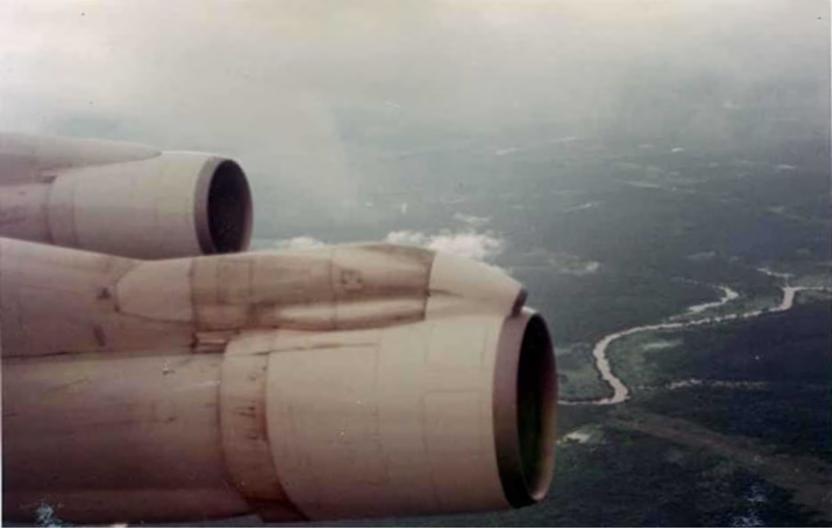
Vietnam was hard-time! And just like serving a prison sentence, you couldn’t see your future until the day you were released through the gate back into the arms of your loved ones. The ecstasy of that moment was experienced when the wheels of our “Freedom Bird” lifted off the runway to begin the 18-hour flight home from Vietnam. The combustible atmosphere and pent-up euphoria permeating the cabin suddenly burst into thunderous applause and deafening cheers as the newest group of returning Vietnam veterans celebrated their survival. We were the lucky ones! We were on our way home! We had our future back!
But what kind of a future does a 19-year-old high-school dropout have to look forward to? If you’re over the age of 40, I’m betting you know the answer to that question.
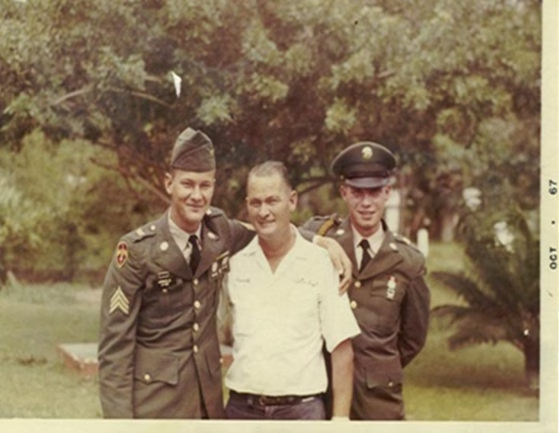
My father met me at the Orlando International Airport for the final leg of the trip home to Vero Beach. Somewhere just north of Yeehaw Junction on a desolate section of the turnpike, I abruptly announced, “Dad, I want to make something out of my life!” As if he’d been waiting to hear those words for an eternity, my father emphatically retorted, “There’s only one way, you’ve got to go to college!”
Like a combat veteran experiencing a PTSD episode, my mind flashed back to January 24, 1965, in my high-school principal’s office, where his words of condemnation loudly replayed in my mind: “Harvey Arnold, if you don’t change your direction in life, you’re headed straight for the state penitentiary!” So in a panicked tone of disbelief, I fired back, asking my father if he had forgotten that I had failed the 6th grade?! Quit high school in the 10th grade?! Missed two full years of English?! And oh, by the way, I had never taken Algebra?!
There in the front seat of the car with my father was the first time I heard the name, Indian River Junior College (IRJC). “And, it’s right here in your backyard!” Now I hadn’t forgotten my pledge to God in the 93rd Evacuation Hospital, but college?! When you’ve experienced nothing but failure in school, just the thought of attending “college” can be as scary and intimidating as receiving your orders for Vietnam. I know it certainly was for me!
Unable to sway me, our conversation gradually transitioned to more comfortable subjects for the rest of the drive home. But a few nights later, my father asked me to accompany him on a visit to his boss’s house, Dr. Eugene Lyon. Dr. Lyon was the City Manager for Vero Beach and my Dad’s boss, but unbeknownst to me, he was also a history professor for the College.
Standing there in his living room that evening, I listened to how the College’s open-door policy was designed for students – just like me – who weren’t college-ready. For all the aforementioned reasons – failed the 6th grade, missed two years of English, never taken Algebra – I gave Dr. Lyon every single reason and sound argument I could think of as to why I couldn’t be successful. But through all of my vocalized fears, self-doubts, and defiant arguments, he remained steadfast in his conviction that IRJC’s open-door policy was a comprehensive commitment to accept students who weren’t college-ready, help them overcome their academic deficiencies, build a strong educational foundation, and ultimately prepare them to succeed at the university level.
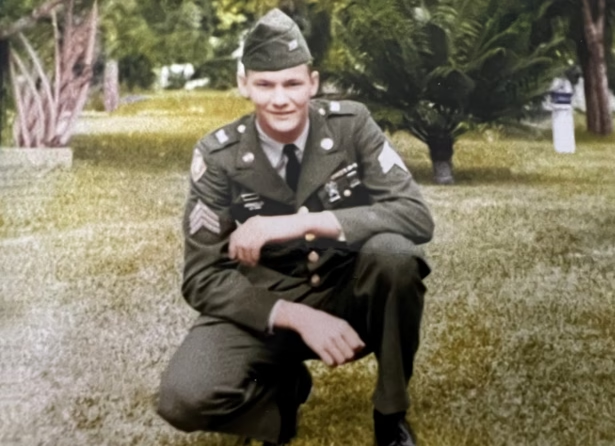
As compelling and reassuring as Dr. Lyon’s responses were to my numerous self-doubts and concerns, I still couldn’t pull the trigger on leaving a promising career with the Army to attend college. Unlike high school, I had been very successful and achieved the rank of sergeant in just under three years. But on the drive home, my father said the magic words to tilt the decision-making scale in favor of college when he said, “You know, if you go to college and graduate, you can become an officer.” Now that was a career path I could identify with!
Seizing the momentum from his persuasive victory, unbeknownst to me my father made an appointment with IRJC’s Academic Dean, Dr. Charles Sample, for the following week. Although I had quit high school in the 11th grade, I had earned my GED while stationed with D Battery, 4th Missile, in Schwabach, Germany. However, Dr. Sample explained that although I had earned my GED, it was insufficient to meet IRJC’s admissions criteria. To be admitted, I’d first have to obtain a High School Equivalency Diploma (HSED) from Florida’s Department of Education (FDOE).
With the above information in hand, my father and I prepared to depart Dr. Sample’s office. As we stood up to leave, he asked if we could spare a few minutes to meet the President. Nodding in affirmation, he escorted us across the hall to President Maxwell King’s office where Dr. King greeted us at the door. Once again, the comprehensive support that Dr. Lyon pledged was reviewed and reinforced by both President King and Dr. Sample.
The latter required me to submit my GED scores in history, math, English, civics, etc. to see if I qualified for a High School Equivalency Diploma. Upon arrival at my final duty station, I immediately submitted the aforementioned GED scores to FDOE. Within a few weeks, FDOE responded that I had indeed met the minimum score requirements to be awarded an equivalency diploma.
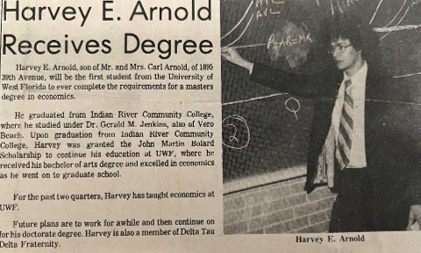
With the comprehensive support I received from IRJC as a student-veteran, I overcame my major academic deficiencies in English and math, built a solid educational foundation, identified my passion for economics, and graduated in 1969 with a full academic scholarship in hand to attend the University of West Florida where I was awarded a bachelor’s and master’s Degree in 1972 and 1974 respectively.
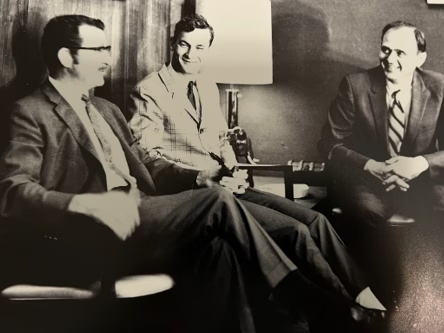
In 2005, I tracked down Dr. Lyon at the Lyric Theater in Stuart and invited him to the IRCC District Board of Trustees Meeting where I recognized him for the impact he had on my life that evening in his home.
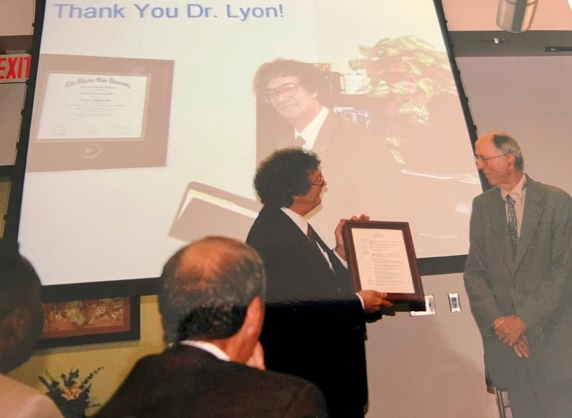
If you took everything Dr. Lyon said that night and condensed it down into one, succinct statement it would read, “If you have the will …. we have the way!”
On a side note, Dr. Lyon is also credited by Mel Fisher for researching the archives in Spain and pinpointing the location of two sunken Spanish galleons with over $400 million of treasure onboard. His contributions leading to their discovery are explicitly acknowledged by the Mel Fisher Museum in Sebastian, Florida.
Regarding my father’s sage foresight about becoming an officer if I graduated from college, I was serving as a 1st Lieutenant with the 3rd Marine Division on Okinawa, Japan when IRCC offered me the faculty position in economics in 1976.
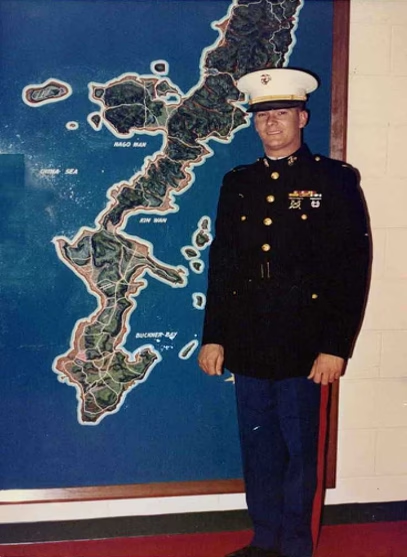
But, the initial offer was conditional on my reporting in August when the new academic year commenced. While writing then-President, Dr. Herman Heise, directly to express my regrets, I also proffered a Plan B: If the College would agree to cover fall classes with adjunct instructors, I’d extend my tour on Okinawa for 90 days, which would have me arriving stateside for discharge in mid-December and available for the Spring 1977 semester. I subsequently received a second letter from Vice President John Muir confirming their acceptance and, “Welcome aboard! The career goal I set to return as the economics professor while still a student at IRJC, was now a reality.
But the best was yet to come! Nothing I achieved during my 53-year affiliation with the College will ever surpass the feeling of accomplishment I felt that first morning when Dr. Muir introduced me to the Faculty as the new economics professor for the College. My former professors were now my colleagues! Their former student had unknowingly achieved the unique distinction of becoming the first IRJC graduate to be awarded a full-time faculty position with the College …. A dream I would be privileged to live for the next 28 years.
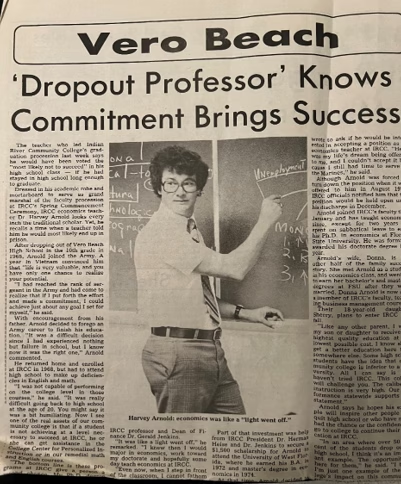
After receiving tenure in 1980, I was granted back-to-back sabbaticals to pursue my highest academic goal of earning a Ph.D. in economics. That goal was realized in August 1986 when I was awarded my Ph.D. from Florida State University. Therefore, I can personally attest to Dr. Lyon’s unwavering faith in the open-door policy by stating, “I was always challenged at the next level, but I was never unprepared!” I can also state without hesitation or reservation that Indian River State College’s highest priority has always been student success. And, that was decades before being honored with the nation’s top award for student success, the Aspen #1 Award, in 2019. I can also attest without any equivocation that Indian River State College deserved the distinction of being a veteran-friendly institution decades before it officially received that laudable designation.
But despite the comprehensive support I received from the College as a student, faculty member and administrator, they couldn’t help me overcome the lingering scars and suppressed memories from serving in the Vietnam War. As I had journeyed through the university system during the height of the War’s growing unpopularity, I was verbally accosted and subjected to further rejection and scorn as I tried to defend our Country’s purpose and involvement. After several painful incidents, I adopted a self-imposed, psychological defense of don’t ask, don’t tell by keeping my opinions and memories to myself. So, like so many other Vietnam vets, I became a closet Vietnam veteran.
But as the page turned to the 21st Century, and the Vietnam War was replaced by the more patriotic wars of Desert Storm, Desert Shield, Operation Iraqi Freedom, and Afghanistan, the public’s appreciation and respect for veterans returned. Once again, veterans were honored and revered for their sacrifice and welcomed home with the respect and dignity they deserved. Symbolic of the renewed appreciation trend, the College created the Veterans Panel as part of International Week, allowing veterans from different wars to share their experiences and field questions from the public and a student-dominated audience.
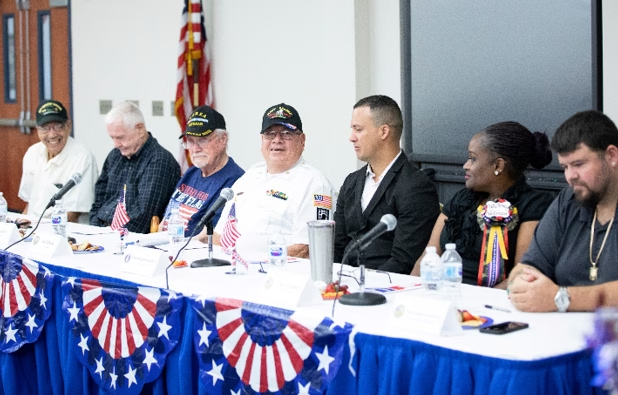
During the early years of the panel’s existence, I declined numerous invitations and requests to serve as a representative of the Vietnam War. Still too gun-shy to come out of the closet, I’d politely decline and refer them to other Vietnam vets working at the College. But as time passed and attrition took its toll, I was eventually the last one remaining. After receiving several phone calls and face-to-face requests to serve on the panel, I finally acquiesced and reluctantly agreed to serve on a one-time basis.
As a closet Vietnam veteran, I hadn’t spoken openly about the War publicly for decades, so I had a formidable psychological hurdle to overcome before my apprehensive debut. But as I began to share the stories and events with my fellow veterans and an appreciative audience, I felt a decades-long burden being lifted from my soul as the years of repressed experiences and pent-up emotions finally found a healthy outlet. What a catharsis! The experience was so therapeutic! To finally share my Vietnam experiences and military stories without the fear of retribution or rejection truly replicated the same cathartic and psychologically healing experience a psychiatrist would want to achieve for their patient.
Although my initial intention was to serve on a one-time basis just to appease the organizers, I went on to serve as a representative of the Vietnam War for the next several years. And in 2004 when I was promoted to Provost of the Pruitt Campus, all future panels were hosted at the Schreiber Conference Center where my role as panelist transitioned to that of moderator.
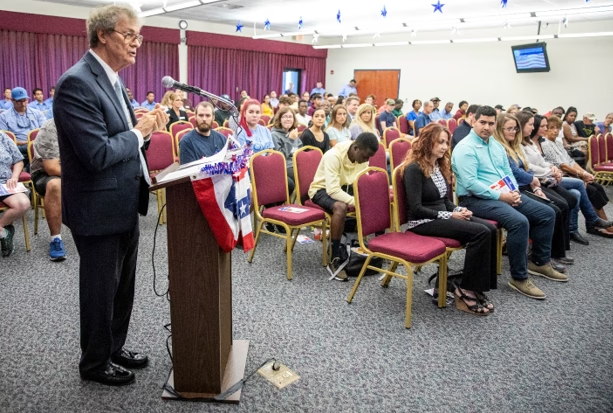
Thanks to the opportunity to serve as a panelist and then moderator of the Veterans Panel, Indian River State College played a pivotal role in restoring my pride in both my military service and my experience in Vietnam. I was no longer a closet Vietnam veteran. The Indian River State College promise has been completed 360 degrees!
However, even with the therapeutic effects of serving on the panel, I learned that certain scars will never fully heal. As part of International Week, we have always had English-as-a-Second-Language students from the Prima Vista Adult Education Center make presentations about their respective countries. On one occasion, the student was from Vietnam. I watched and listened intently as she scrolled through pictures in her PowerPoint presentation, enlightening the students about Vietnam’s demographics, geography, and cuisine. Suddenly, a picture of North Vietnam’s flag appeared on the screen. Like being sucker punched, I was blindsided and unnerved by the unanticipated reminder! Consequently, I immediately left the event and walked around the campus to regain my composure. After that traumatizing experience, I realized Vietnam would always be part of my DNA and flashbacks would never be more than a song, smell, sound, picture, or comment away from being triggered and catapulted into the present.
With my 2021 retirement, the College prepared a generous news release crediting me for helping craft the proposal that secured the $450,000 grant to create the Veterans Center of Excellence, serving as moderator of the Veterans Panel for over 15 years, and being selected by G.I. Jobs Magazine as a 2021 Veteran Champion for Education.
But it’s not the College that owes me! If a monetary value could be assigned to the positive net worth I contributed during my 44-year career with the College, it wouldn’t even begin to pay the interest on the debt of gratitude I will always feel for the way the College supported me as a returning veteran on two separate occasions.
When outcomes in our lives escape the realm of explanation by incorporating all the available facts and circumstances, we often ascribe the outcome to a more omnipotent force – God! That deference to a higher power seems most appropriate for comprehending my life’s journey: In retrospect, it almost seems like God must have placed “The River” in my path just so I could honor my predawn pledge in the 93rd Evacuation Hospital.
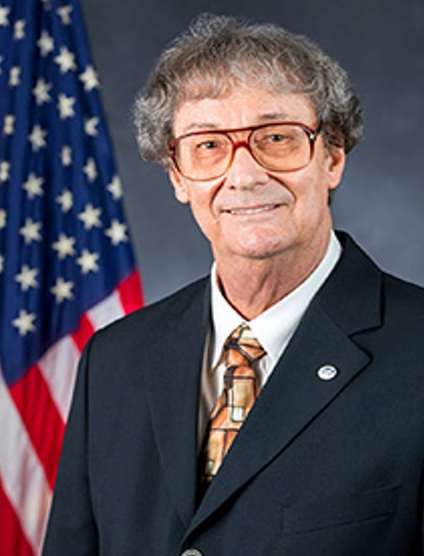
Harvey Arnold was a professor and administrator at Indian River State College for 44 years, including 17 as provost/president of the Ken Pruitt Campus in Port St. Lucie.