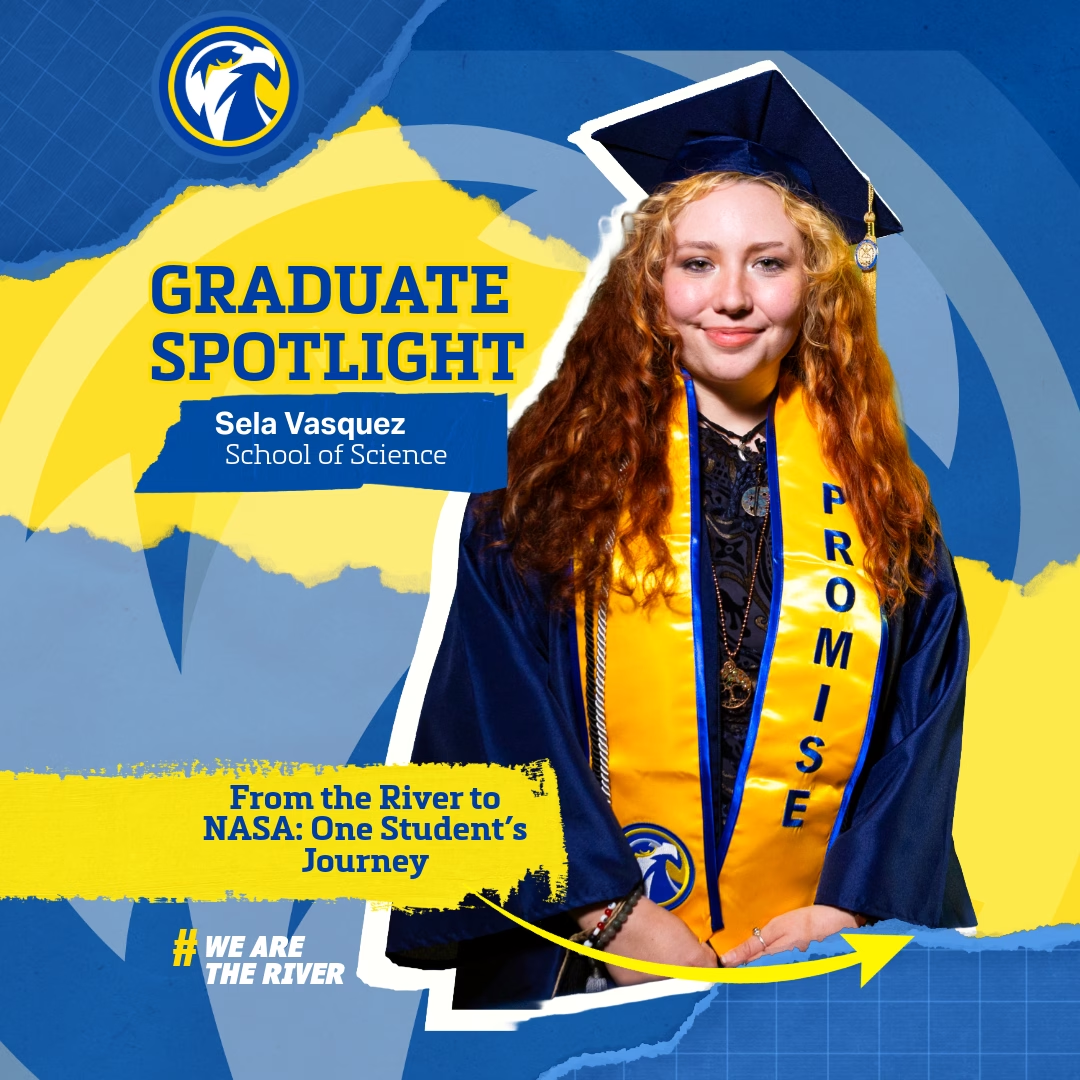
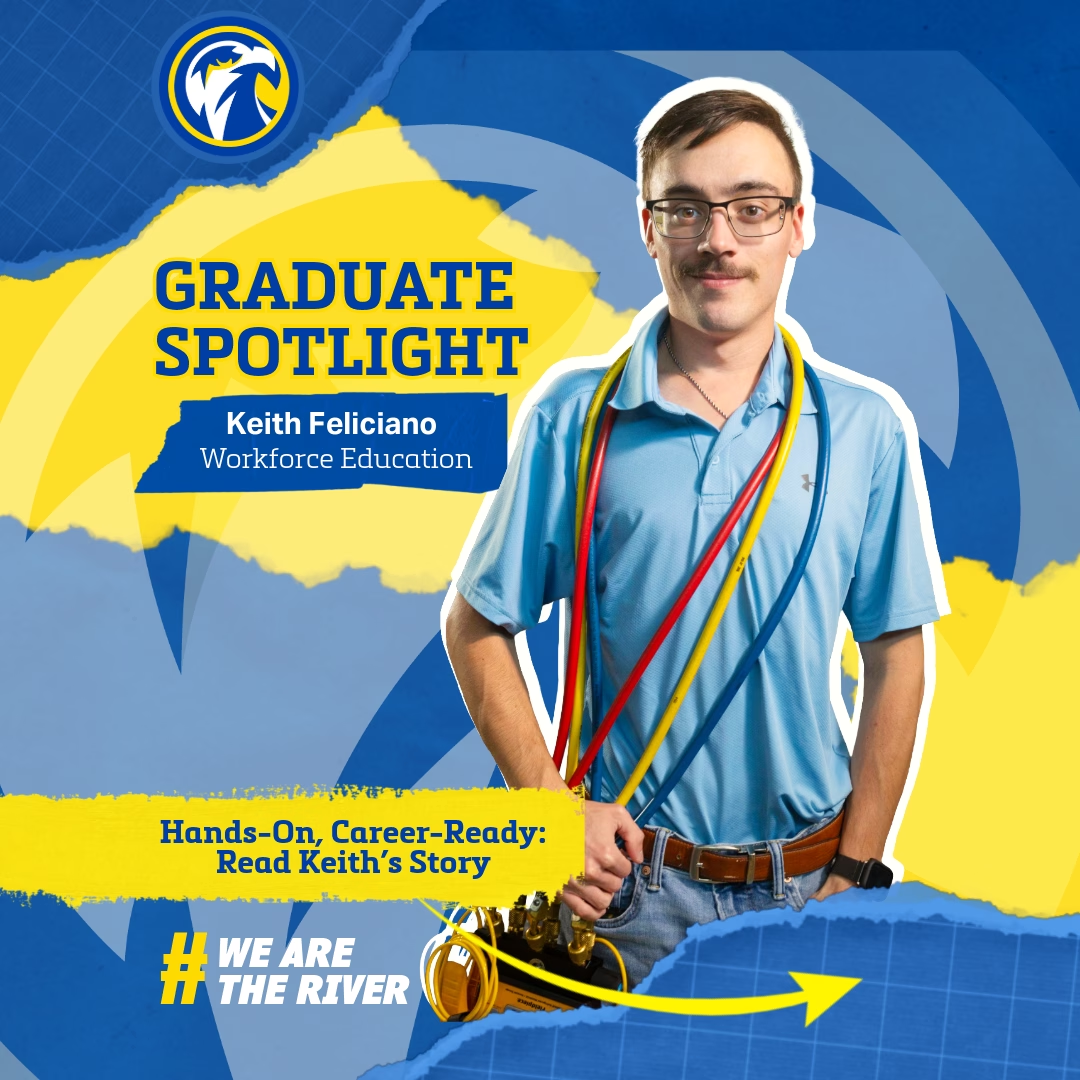
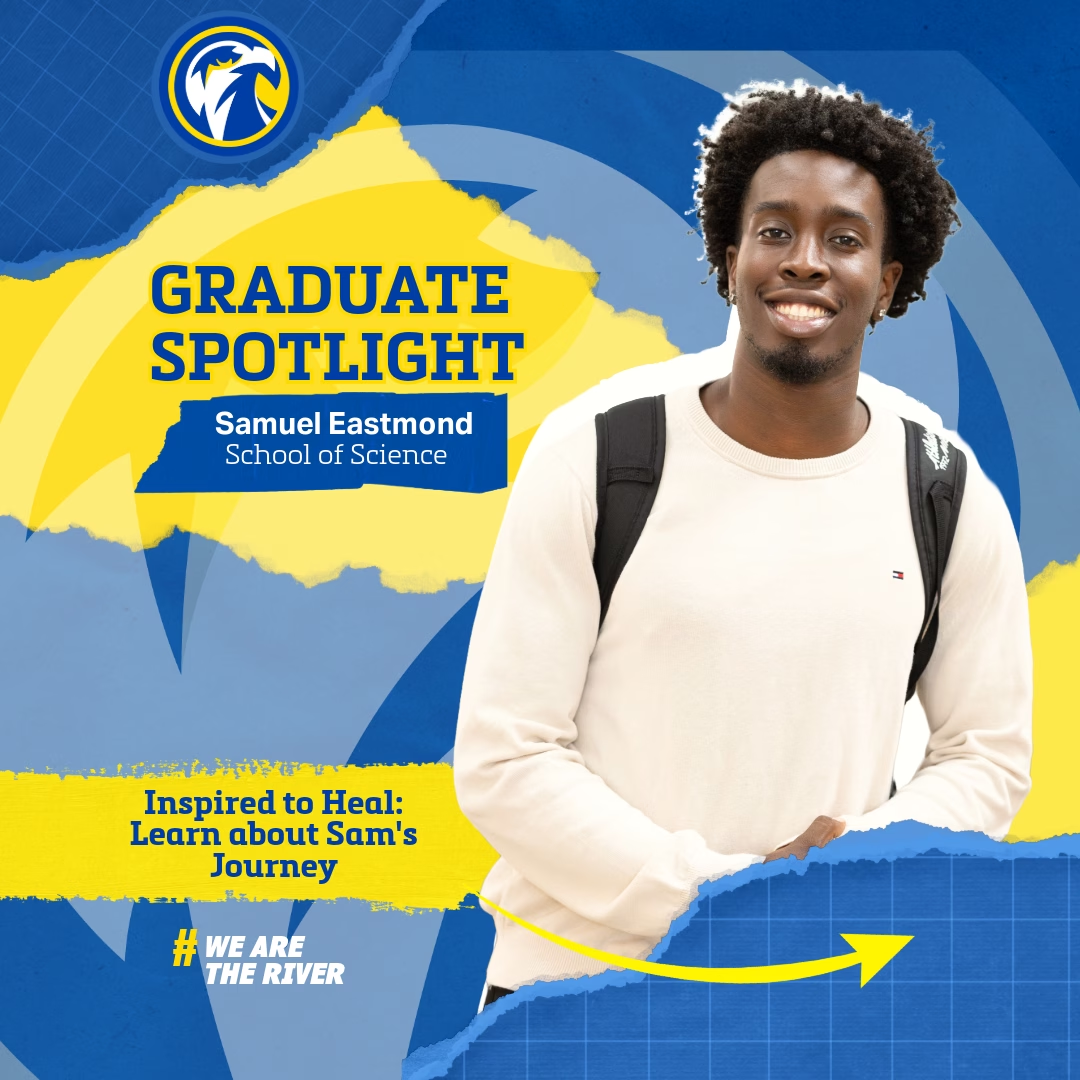
Discover inspiring graduate success stories from Indian River State College that highlight perseverance, innovation, and the pursuit of meaningful careers. From space exploration to healthcare and nursing, these spotlights showcase how River students are overcoming challenges, achieving their goals, and ready to make an impact in their communities.
FORT PIERCE, Fla. (November 3, 2025) — Indian River State College (“The River”) is pleased to announce that its Tutoring Center – encompassing course-embedded learning assistant, peer tutor, and tutor programs – has been awarded certification as Level 1 and Level 2 certified tutor training programs by the internationally recognized College Reading and Learning Association (CRLA).
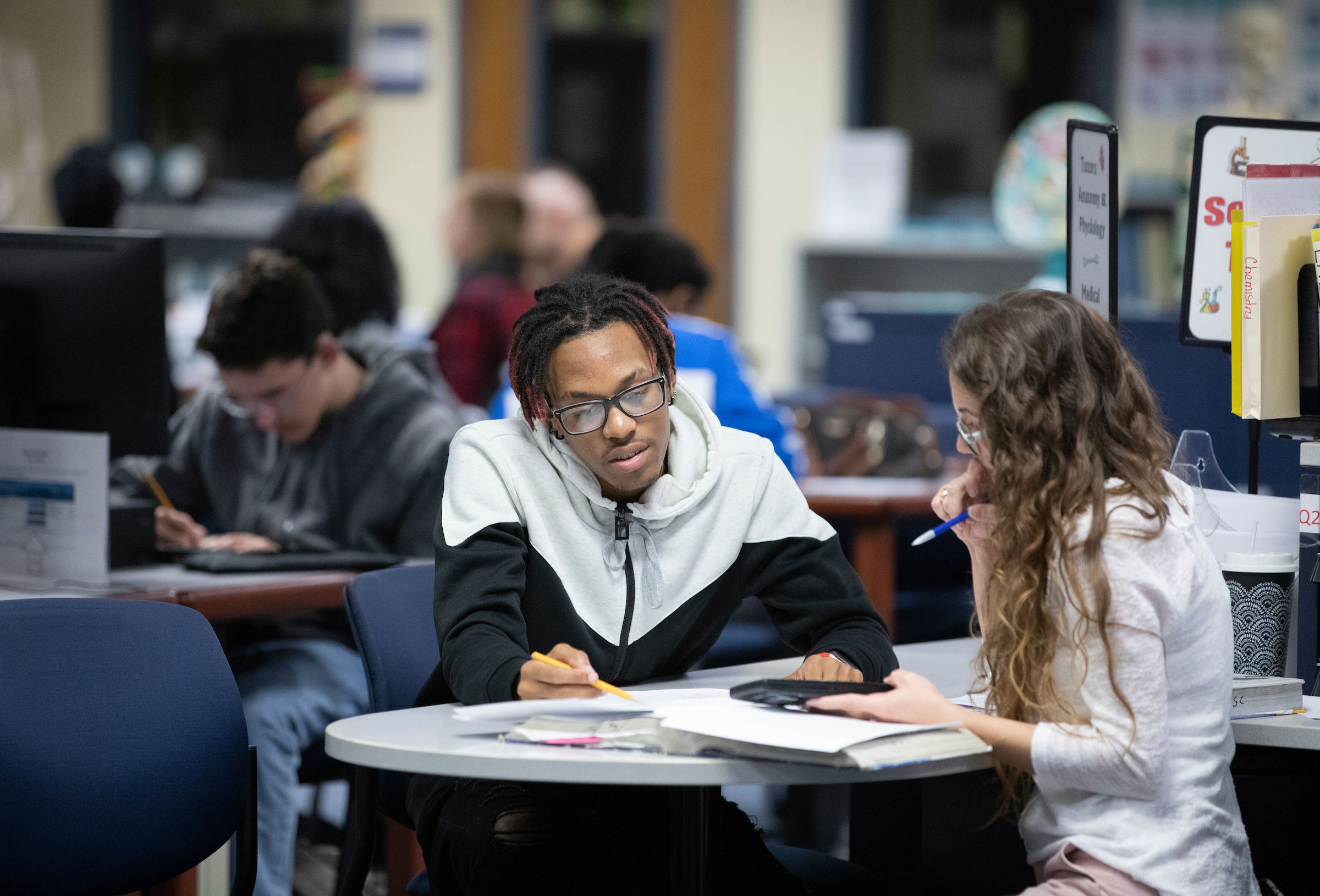
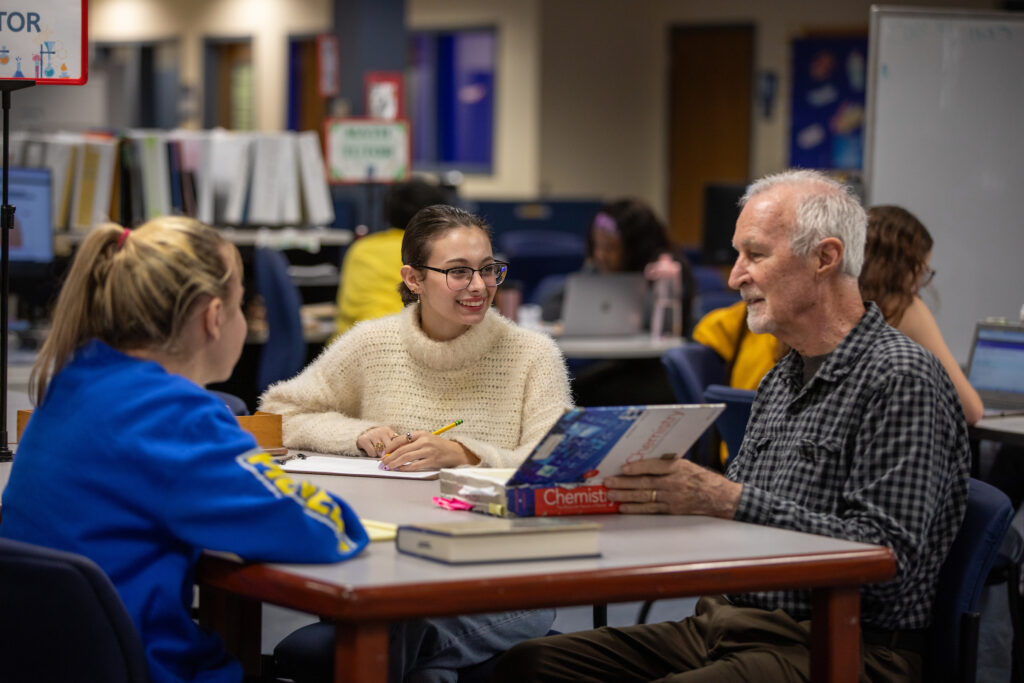
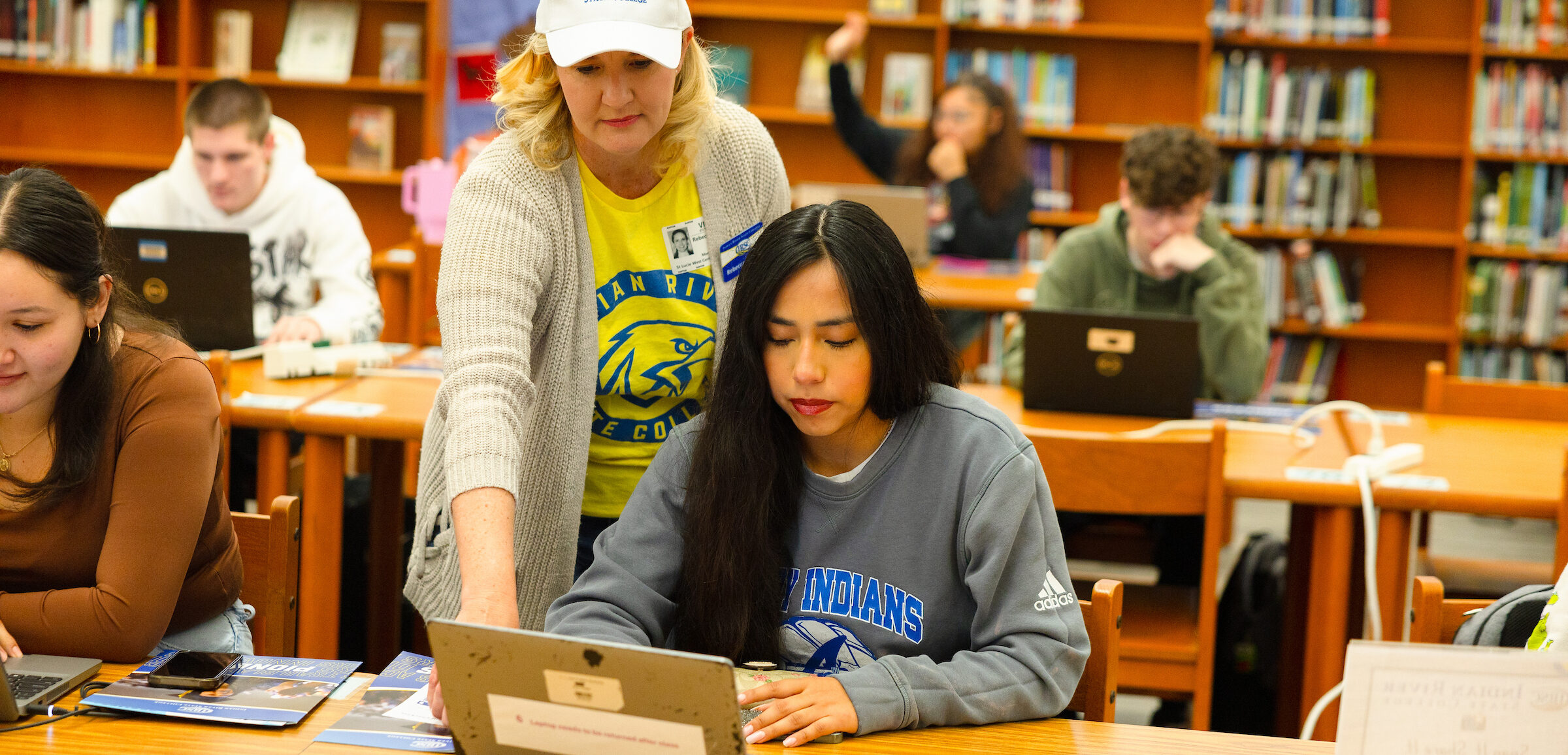
The River’s Academic Support Center provides professional tutoring across all subject areas to help students succeed.
For more than 30 years, CRLA has been a leader in learning assistance, reading, and academic support programs with almost 1,300 members and over 2,000 certified training programs worldwide. The organization’s International Tutor Training Program Certification (ITTPC) recognizes tutor training programs that have demonstrated excellence in developing, designing, and implementing effective training procedures.
Indian River State College has worked diligently to develop a tutor training program that meets CRLA’s rigorous standards and has successfully completed the ITTPC peer review process. Achieving this certification means that The River has met CRLA’s high standards for tutor selection, training, direct service, and evaluation as an integral part of its overall tutoring program.
“This certification represents our commitment to providing the highest quality academic support services to our students,” said Dr. Timothy E. Moore, Indian River State College president. “By meeting these internationally recognized standards, we are ensuring that our tutoring programs not only support student success but also provide valuable professional development opportunities for our student tutors.”
The certification brings significant benefits to The River and its students. It sets a benchmark for academic support excellence across the institution, ensures compliance with internationally recognized best practices in higher education tutorial services, and strengthens the connection between curriculum and academic support services.
“Students benefit immensely from working with tutors who are trained in effective helping strategies, communication skills, and structuring the tutoring experience,” said Dr. Lynne O’Dell, Director of STEM Pioneer/School of Science and Adjunct Student Success. “This certification validates the quality and professionalism of our tutoring program and ensures that every student receives support from trained para-professionals who understand best practices in academic assistance.”
For student tutors and learning assistants, the certification provides valuable career development opportunities. Many Indian River State College learning assistants and peer tutors who have transferred to universities have secured employment on campus as tutors because they worked at an institution holding CRLA certification. The program teaches skills commensurate with best practices, increases confidence in content areas and public speaking, and strengthens resumes with an internationally recognized certificate.
“Supporting our students’ academic journey is at the heart of what we do at Indian River State College,” said Dr. Heather Belmont, Indian River State College provost. “This CRLA certification demonstrates our dedication to excellence in every aspect of student support, from the classroom to the tutoring center. We’re proud to offer services that meet the highest national standards.”
Florida welcomed a record-breaking 143 million visitors in 2024 – nearly 3 million more than the previous year. But here’s the challenge facing the Treasure Coast and beyond: 76% of hotels nationwide are experiencing critical staffing shortages, with housekeeping being the most urgent need.
The hospitality industry is booming, but it desperately needs trained professionals. That’s where Indian River State College comes in.
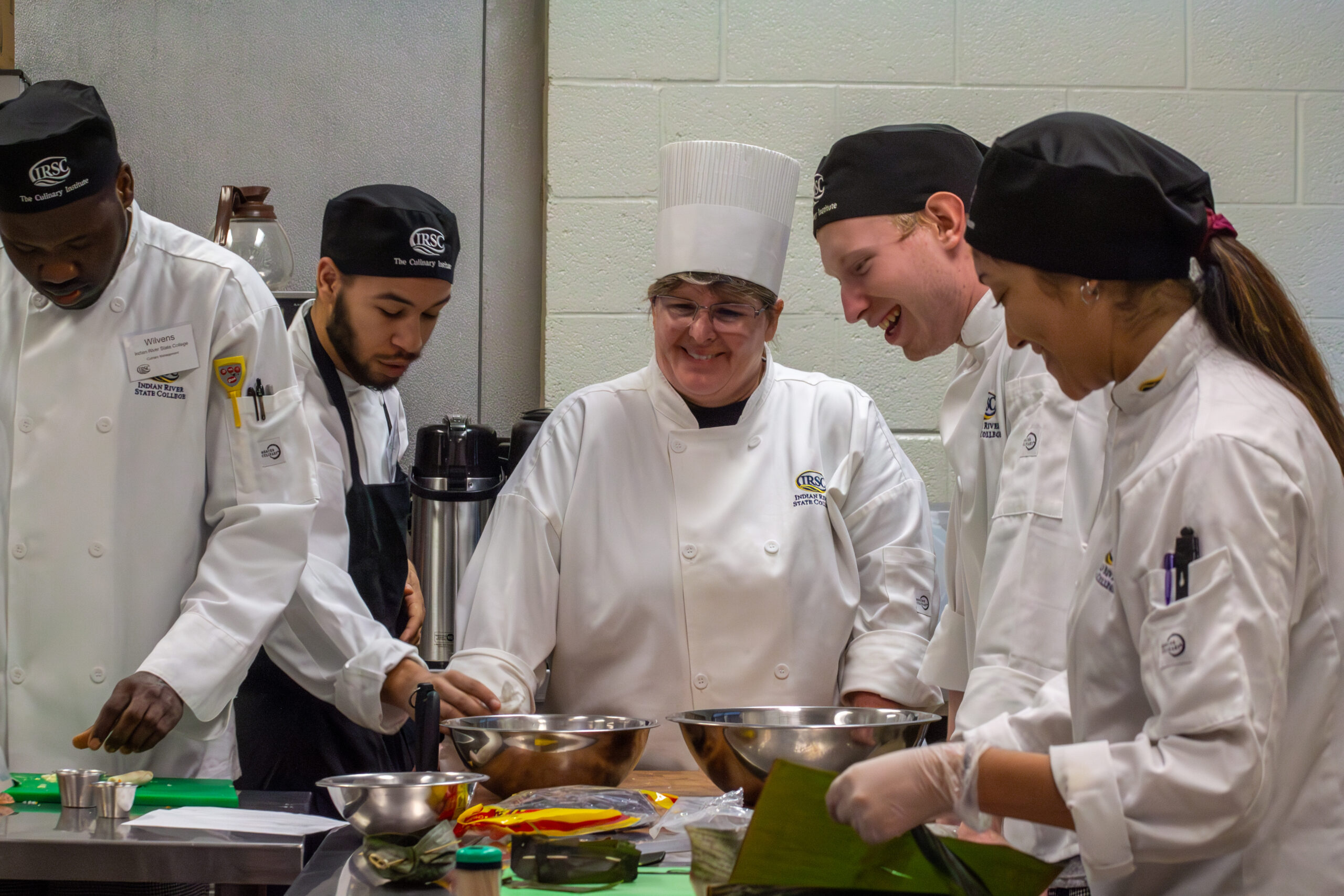
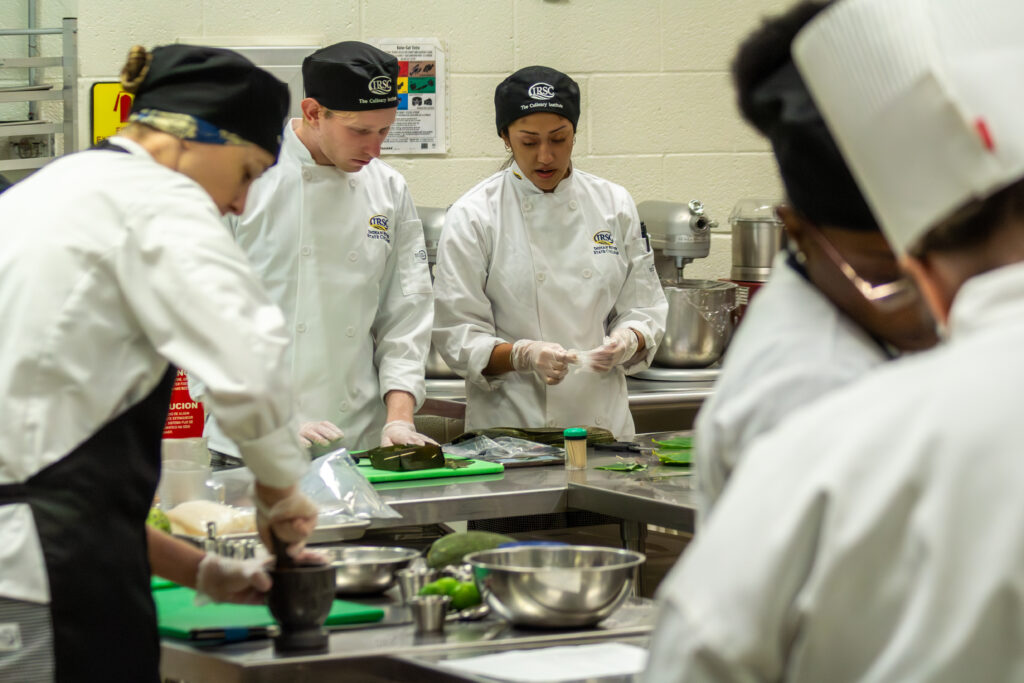
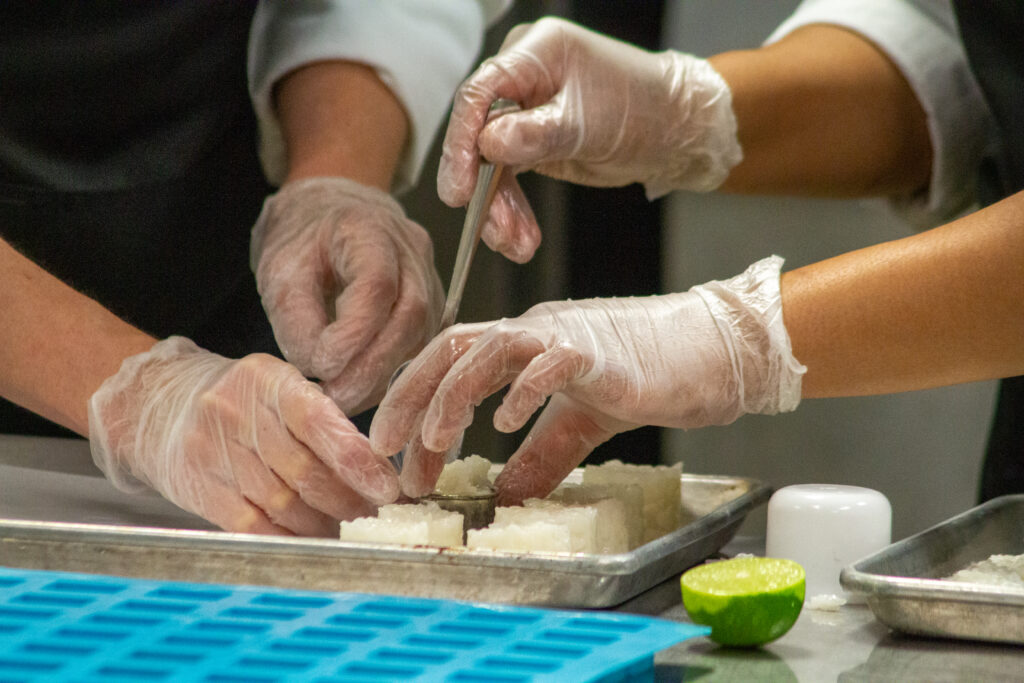
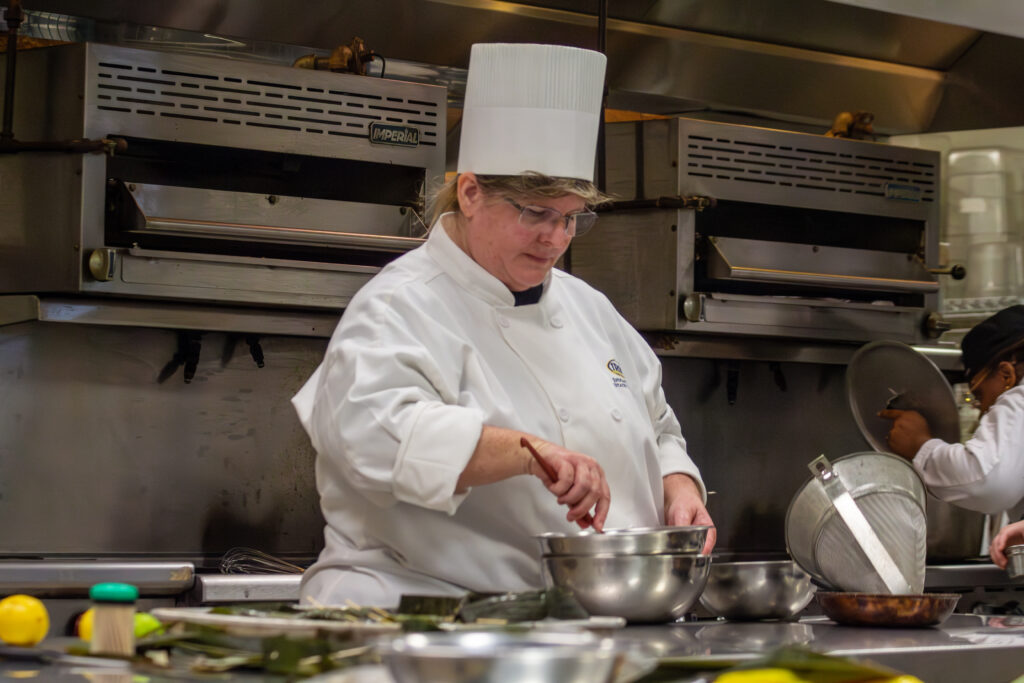
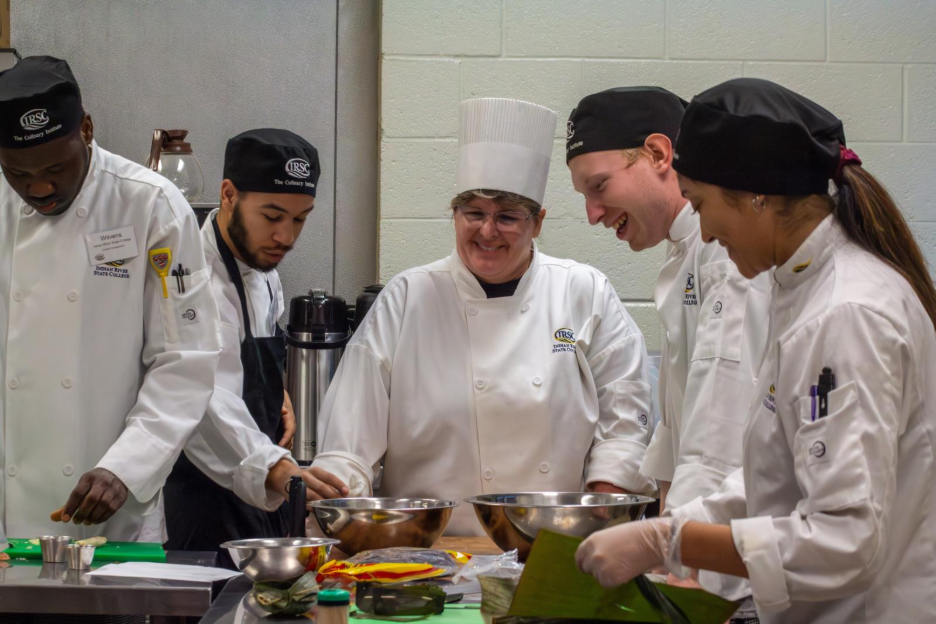
Students in Chef Deborah Midkiff’s International and Regional Cuisine class at Indian River State College prepare a menu on October 25, 2023.
Building the Pipeline
In a recent episode of RiverTalk on IRSC Public Media, host Kathleen Walter sat down with Professor Deborah Midkiff, chair of the Hospitality and Culinary Management Department, along with students Megan DiPietro and Emily Day. Their conversation revealed how The River is addressing the workforce gap right here on the Treasure Coast.
“I think a lot of times people feel that what we do only happens in the classroom with our students, and that certainly is a big piece of it, preparing them for the workforce,” explained Professor Midkiff. “But another piece of that is, how do we connect all the pieces of the pipeline?”
That pipeline starts as early as middle school, exposing young students to hospitality and culinary careers. It continues through partnerships with local high schools, connections with employers seeking great talent, and even pre-apprenticeships in the area.
Students in Chef Deborah Midkiff’s International and Regional Cuisine class at Indian River State College prepare a menu.
More Than Just Cooking and Serving
Many people think hospitality education is limited to learning to cook or serve tables. The reality is far more expansive.
Indian River State College offers a two-year AS in Hospitality and Tourism Management, covering food and beverage, special event management, lodging, and travel and tourism. Some students have gone on to work with the county tourism board. The college also offers a degree in Culinary Management, where students learn not just cooking techniques but the leadership skills to become future sous chefs and executive chefs.
One standout program is the Culinary Apprenticeship – an “Earn While You Learn” initiative. It’s a one-year, tuition-free program where students work 40 paid hours per week in restaurants that cook from scratch, rotating through stations under highly skilled chefs.
Recently, Indian River State College reinvigorated its two-year Restaurant Management degree for students specifically interested in the restaurant side of hospitality, without the lodging component.
Students in The River’s Hospitality and Culinary Management programs gain hands-on experience in state-of-the-art kitchen classrooms, preparing for careers in Florida’s booming tourism industry.
Real Students, Real Success
Megan DiPietro came to Indian River State College after working at and managing a coffee shop. “I didn’t really know what I wanted to do,” she recalled. When she discovered the culinary management program, she realized it combined two things she loved: working with food and management.
Now working at Sweet Desires Bakery, Megan sees how her education translates directly to the workplace. “The program gives you a base, a nice foundation for wherever you go to work,” she said. “Even when I went into working at the bakery, I had very little experience with that. But I was able to hit the ground running.”
Emily Day was drawn to hospitality because of her experience in food and beverage and managing personal estates. “I just kind of saw this degree option and thought that it was a good opportunity to kind of broaden my understanding of hospitality and the options that it offered,” she explained. In addition, Emily completed a summer internship at Chef’s Table Restaurant in Stuart and now has a position with them working with special events and catering.
What Employers Really Want
Indian River State College meets quarterly with an advisory board of industry professionals from restaurants, hotels, and even medical facilities that need hospitality workers. Their consistent message? Soft skills matter most.
“We’ve continued to hear soft skills,” Professor Midkiff noted. “What we’re really narrowing it down to is communication skills, teamwork… time management, prioritization are key things that they’re looking for.”
These skills are woven directly into the curriculum and reinforced through extracurricular events where students take on leadership, planning, and visionary roles.
Professor Deborah Midkiff, chair of the Hospitality and Culinary Management Department, prepares students for leadership roles in Florida’s growing hospitality industry.
A Booming Job Market
The employment picture for hospitality graduates is encouraging. According to Professor Midkiff, average hotel wages have increased 26% since the pandemic. “I’ve seen more of our students over the past three or four years being in positions where they can get promoted into better positions faster,” she said. “Instead of waiting for those opportunities 10 or 15 years, I’m seeing a lot of our really sharp students move into leadership roles within one or two years.”
By 2033, the Bureau of Labor Statistics projects that one in eight new jobs will be tied to hospitality or leisure.
The Technology Factor
Technology is reshaping the industry, but not replacing workers – it’s changing what workers do. From robotic vacuums for housekeeping to AI helping managers with paperwork and predictive analytics, technology is removing some of the physical burden and making professionals more productive.
“AI is not going to take over our jobs, but people that understand how to use it are going to be the ones that get hired for the position,” Professor Midkiff emphasized. The industry will see less blue-collar work and more white-collar, IT-focused, better-paying careers.
Beyond Stereotypes
Hospitality and culinary careers extend far beyond front desk clerks and line cooks. The industry needs IT professionals, finance and accounting experts, scheduling systems specialists, and as virtual reality becomes more prevalent, even more white-collar positions.
Students notice evolving trends too. Emily observes that while some guests want the convenience of mobile check-ins and online payments, others still crave face-to-face personal connections. “There’s still that need for face-to-face personal connection,” she noted.
Megan sees changing tastes in food: “Everyone loves that bright color, the bright flavor… They want things that are simple and just have this nice bright flavor, not so sweet.”
Advice for Future Students
Both students had encouraging words for anyone considering the field.
Emily emphasized the versatility: “There’s just so many options in it. You’re not going to be narrowing yourself into anything too specific… It just gives you a really good baseline education.”
Megan’s advice? “Work a summer job and see if you like it. Then take the leap and apply for a program. Even if you don’t end up using the skills you’ve learned and going into a full-time career in whatever path you choose, it’s still skills that you will take with you for the rest of your life.”
The holiday season is upon us – a time when the hospitality industry shines brightest. Behind every perfectly executed meal and seamlessly managed event are trained professionals like Megan and Emily, who’ve turned their passion into careers at The River.
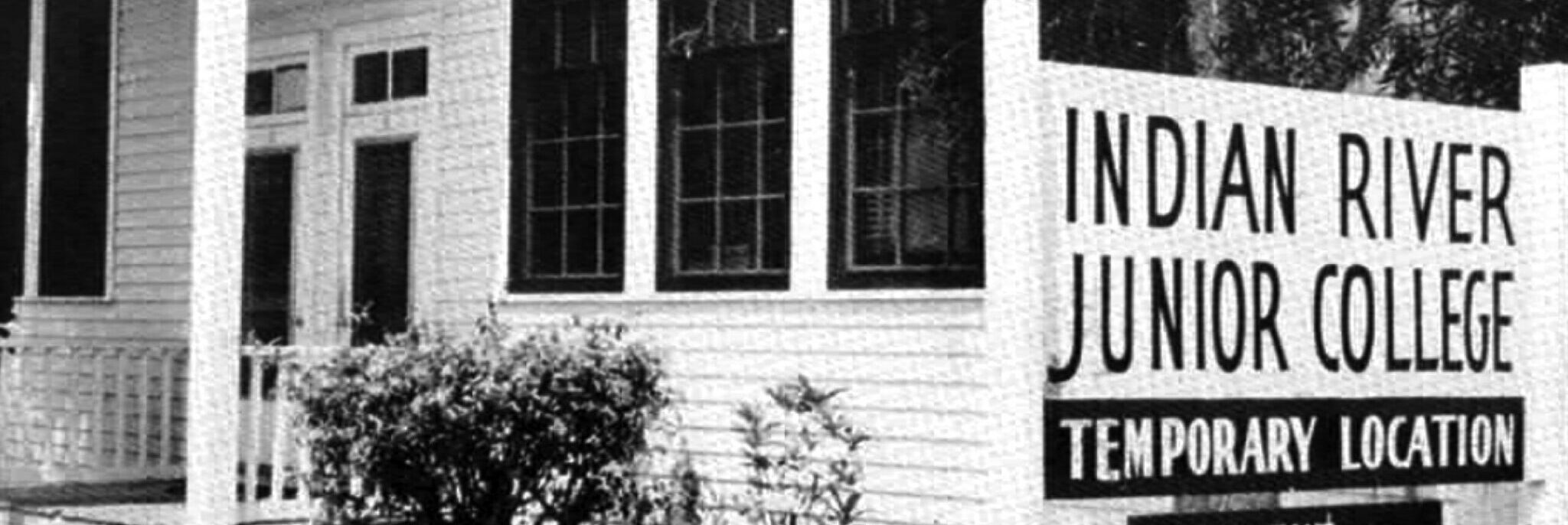
The Florida Legislature officially established Indian River Junior College on January 1, 1960.
By Kathleen Walter
From a single building in 1959 to five campuses serving nearly 24,000 students today, Indian River State College has become far more than an educational institution—it’s a lifeline for the region.
On a recent episode of RiverTalk on IRSC Public Media, two people who embody this remarkable journey shared their perspectives: Dr. Mia Tignor, Associate Vice Provost of Academic Affairs and college historian, and Professor June Wells, who has taught here for an extraordinary 53 years. Their conversation revealed not just the facts of Indian River State College’s evolution, but its soul.
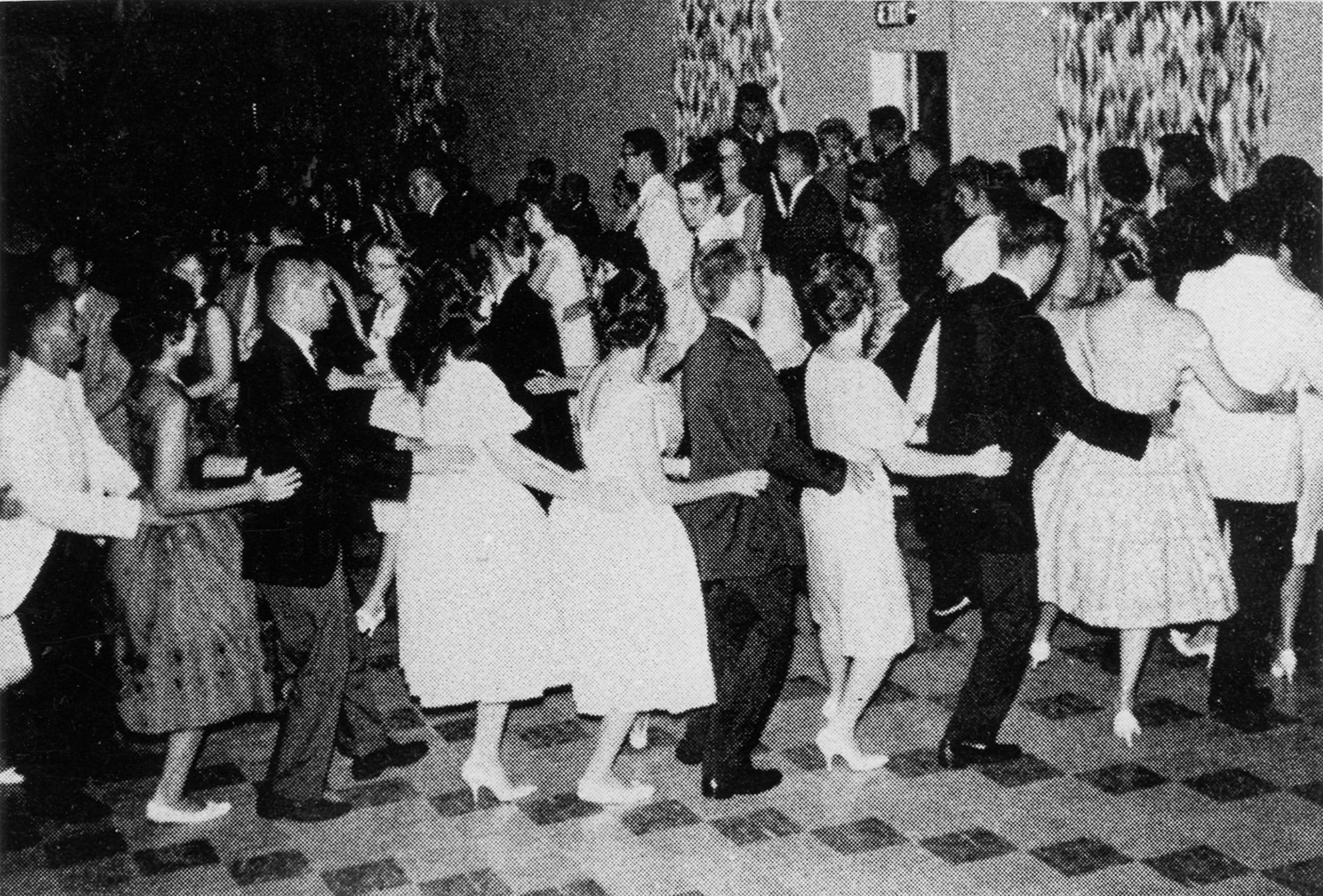
A black and white photo of men in suits and women in dresses doing the conga dance.
From Junior College to State College
The transformation from Indian River Junior College to a state college authorized to grant bachelor’s degrees in 2008 stands as a pivotal moment. As Dr. Tignor explained, this shift allowed Indian River State College to serve students “across all levels of education”—from adult education through bachelor’s programs—making higher education accessible in a region where Indian River State College remains the only public institution serving four counties.
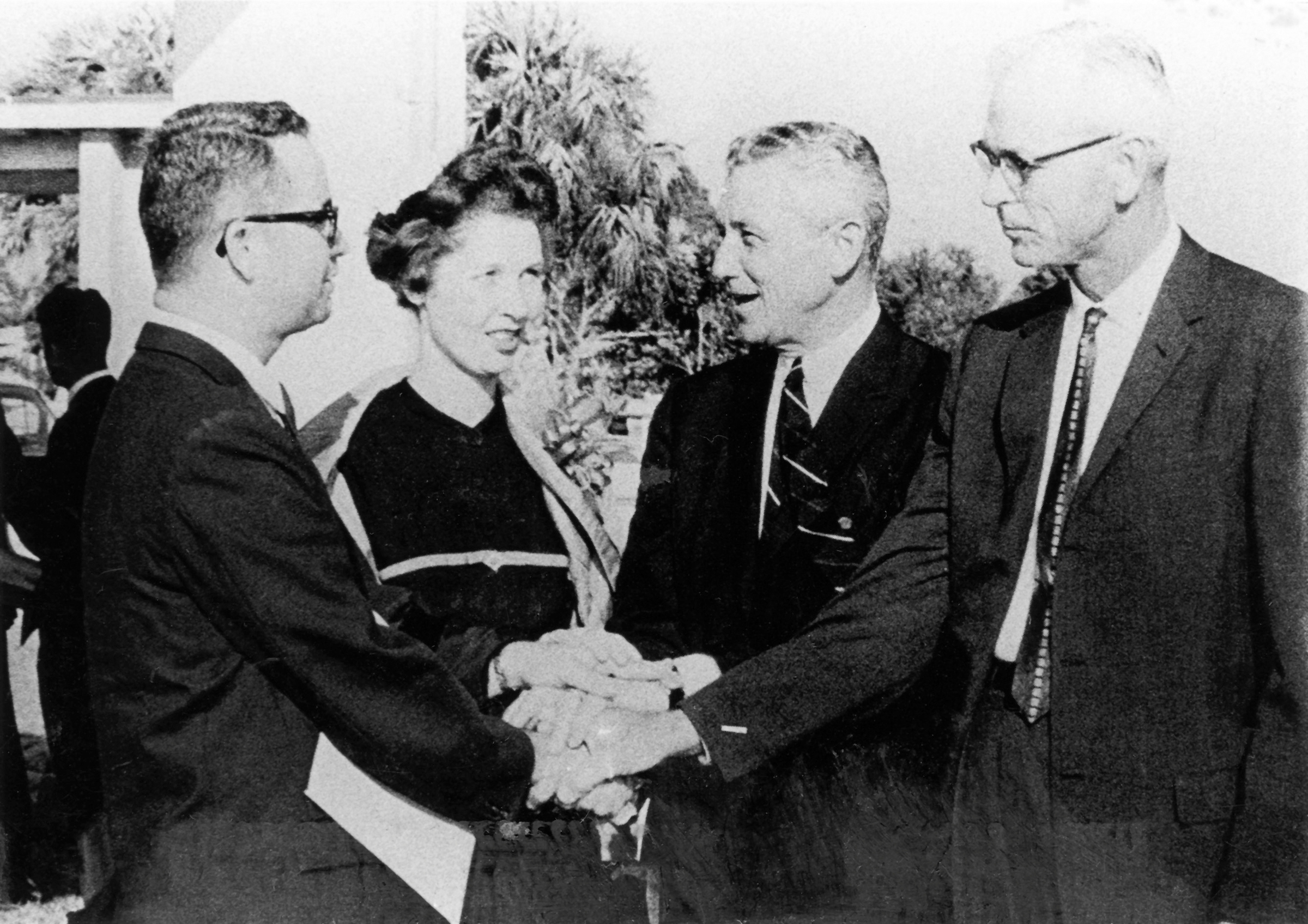
Congratulations to IRJC President Max King and Mrs. King (left) from Governor LeRoy Collins and Senator Harry Kichliter on the establishment of Indian River Junior College.
Professor Wells helped architect this change, literally building the bachelor’s programs in education from the ground up. “It was basically the idea that we were trying to make education available to a bigger kind of population,” she recalled, describing how faculty created courses, wrote syllabi, and adapted content for specialized populations in law enforcement, fire science, and other fields.
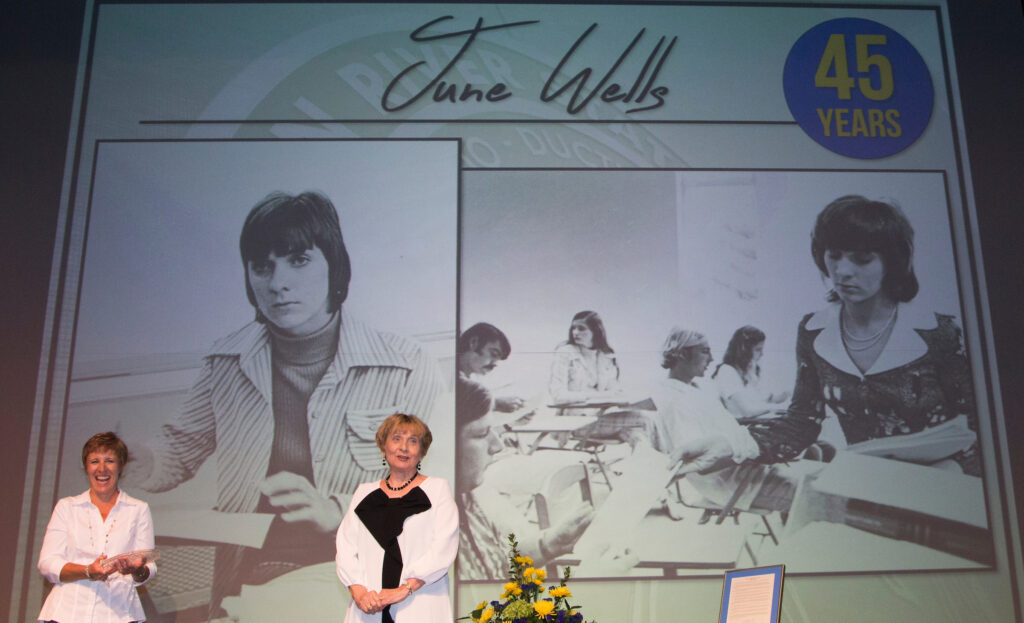
Professor Wells was recognized for 45 years of service to the college in 2018.
The Geography of Opportunity
Spanning Fort Pierce, Vero Beach, Stuart, Okeechobee, and Fort St. Lucie, Indian River State College’s five-campus footprint shapes its identity in profound ways. Each campus serves distinct populations with unique needs, requiring flexibility in how resources are deployed. At the Pruitt campus, for instance, a joint-use library with St. Lucie County offers early literacy programs for an up-and-coming community—services that might look different at the Fort Pierce campus where other resources exist.
A Personal History
When Professor Wells arrived in 1973 as faculty member number 37, she could barely find Fort Pierce on a map. Fresh from the University of South Florida with a master’s degree in rhetoric and public address, she joined a small institution with just four or five buildings. But she quickly understood her mission: showing young people, especially young women, what they could become.
“Dr. Heise said to me, I want you to go out there and show people, especially young ladies, what they can become,” Wells remembered. In an era when college wasn’t assumed for women, she literally walked students from her neighborhood to registration, helping them believe they belonged in higher education.
Integration’s Legacy
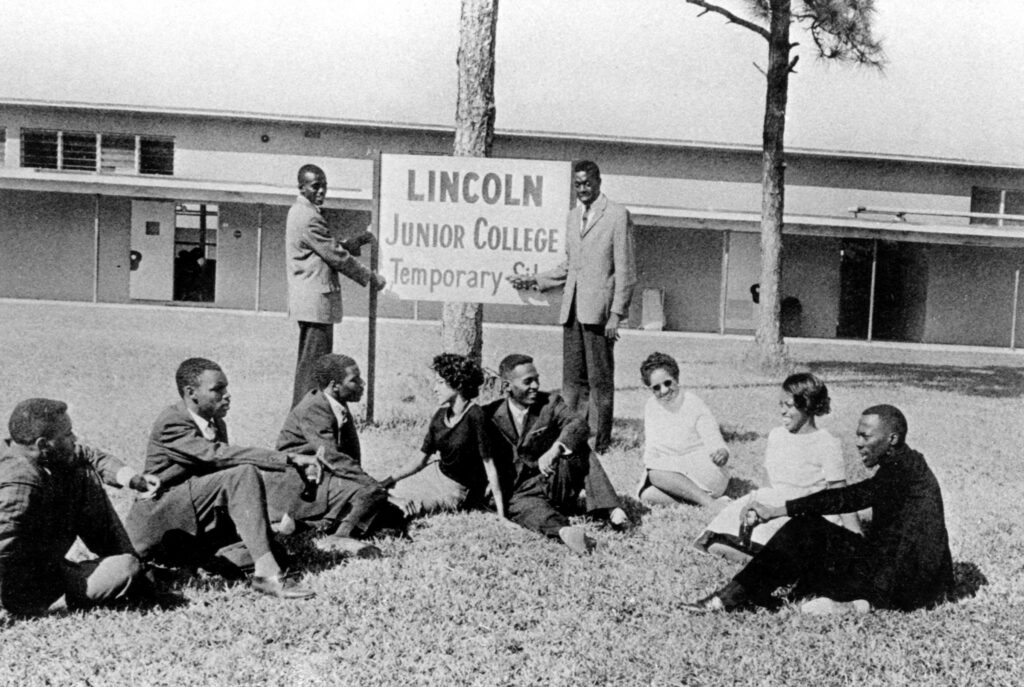
Eight years before Wells arrived, Indian River Junior College merged with Lincoln Junior College as part of integration in 1965. While she inherited this history rather than lived it, she saw its effects—a conscious effort to bring diverse populations together and create a welcoming environment.
Lincoln Junior College was established in 1960.
Digital Evolution
The college’s learning infrastructure has transformed dramatically. Dr. Tignor traced this evolution from the library’s opening in the late 1960s—with its card catalog and physical books—through online catalogs, and now to comprehensive digital resources. Her mother attended library school with card catalogs; Tignor studied an entirely different system 20 years later.
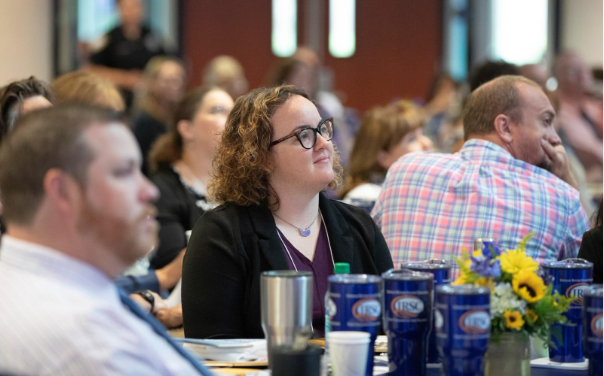
Dr. Tignor attends a college event in 2018.
Today’s students access Adobe Creative Campus tools, Bloomberg Terminals, Wolfram Alpha, and institutional Grammarly subscriptions—professional-grade resources once available only to those already in industry. The 2013 launch of Indian River State College Online expanded flexibility even further, building on earlier innovations like VHS video classrooms that streamed to campuses without resident faculty.
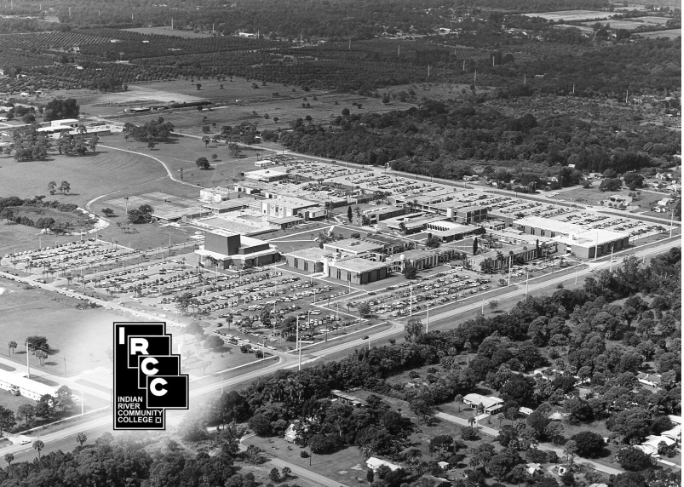
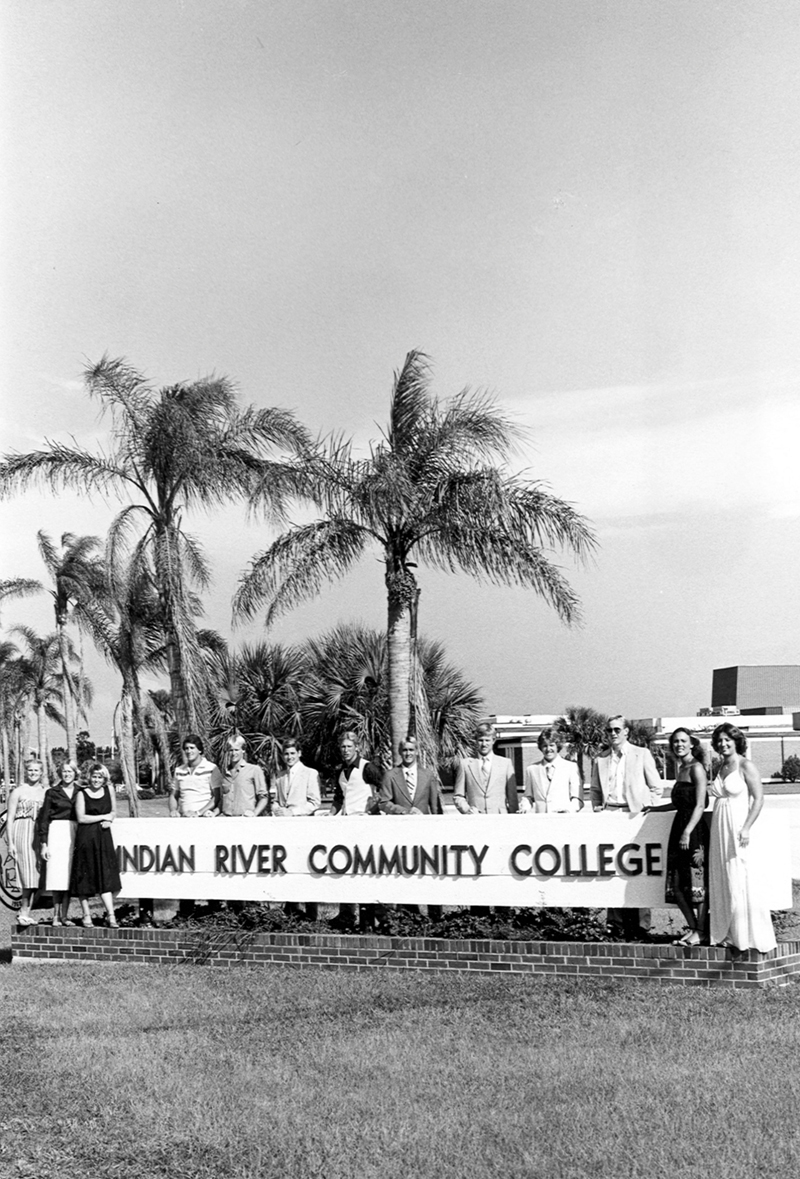
Indian River Community College in 1983
What Endures
Despite all this change, Professor Wells identified something constant: the relationship between faculty and students. Unlike her own college experience, where professors seemed distant, she’s always maintained an atmosphere where students feel comfortable asking questions, seeking help, admitting confusion. “Never be told that’s a stupid question,” she emphasized, understanding that one dismissive response silences the next person.
This culture of accessibility connects directly to The River’s founding purpose. The junior college system emerged after World War II to meet workforce education needs that four-year institutions couldn’t accommodate alone. The recent Promise Program, which helps make college tuition-free for eligible local students, continues this tradition of opening doors for those who might not have thought college was an option.
Bold Moves Forward
Recent years have brought dramatic developments: a $45 million gift from MacKenzie Scott, the Eastman Advanced Workforce Training Complex, expanded nursing facilities that double capacity, and programs in rail industries, ballistics technology, and advanced manufacturing. The Center of Excellence for Veteran Students Success recognizes another population Indian River State College serves. These transformative initiatives occurred under the leadership of Indian River State College President Timothy E. Moore in 2020.
How does the college stay ahead of economic needs while remaining true to its mission? Dr. Tignor described a two-tiered approach: maintaining strong core programs like the Associate in Arts while partnering with industries to offer new certifications and short-term training for students who don’t need traditional degrees.
12,000 Students and Counting
Professor Wells has taught more than 12,000 students—a number she processes by remembering individual speeches rather than faces that have aged forty years. Students return and ask, “Do you remember my speech?” And often she does. Citrus blackfly. She remembers.
What drives someone to show up, in person, after 53 years? For Wells, it’s seeing how populations and needs change. Public speaking still needs teaching, but now she incorporates interview skills, because employers report young people “don’t interview well.” The content evolves; the commitment remains.
She wants future generations to remember that The River got them “on the starting block.” Many students tell her their best educational experience happened here. One became a state senator. Others built successful careers from that foundation.
Looking Ahead
What makes them proud? Professor Wells pointed to the college’s ability to see needs and evolve, to find people who can meet those needs and dedicate themselves to making things work. Dr. Tignor spoke of faculty and staff’s extraordinary care for students—a throughline she sees in archival materials from the 1970s through today’s blog posts and course discussions.
“Students are students, faculty are faculty,” Tignor observed. That focus on student success, that care from faculty and tutors and librarians, appears throughout Indian River State College’s entire history.
Students show their River pride in 1980.
Sixty-five years after opening in a single building, Indian River State College remains what it always was: a community deciding that education should be within reach, no matter who you are or where you come from. That commitment endures.
FORT PIERCE, Fla. (Oct. 17, 2025) – Indian River State College (“The River”) and Florida International University (FIU) have announced a new articulation agreement that will provide a seamless transfer pathway for students pursuing careers in hospitality and tourism management. The partnership allows graduates of The River with an Associate in Science degree in Hospitality and Tourism Management to transfer directly into FIU’s top-ranked Chaplin School of Hospitality & Tourism Management to complete their bachelor’s degree in Hospitality & Tourism Management. Students will complete their BS in Hospitality & Tourism Management one semester faster and will save over $1,250 in tuition costs with this agreement.
The agreement addresses the critical need for qualified hospitality professionals in Florida’s tourism industry, which generated a record $128 billion economic impact in 2023 statewide. The Treasure Coast region, served by The River, plays a vital role in this economic engine, contributing significantly to the state’s position as a premier tourism destination.
“This partnership with FIU represents a tremendous opportunity for our students to advance their education and career prospects in one of Florida’s most important industries,” said Dr. Timothy E. Moore, President of Indian River State College. “By creating this direct pathway to a four-year degree in hospitality and tourism, we’re ensuring our graduates have the credentials and knowledge needed to assume leadership roles in hospitality and tourism management. This agreement reflects our commitment to providing students with affordable, accessible education that leads to meaningful career opportunities in high-demand fields.”
FIU’s Chaplin School of Hospitality & Tourism Management is ranked 4th in the U.S. and 31st in the world, making this partnership particularly valuable for Indian River State College students seeking to advance their careers.
Students in Chef Deborah Midkiff’s International and Regional Cuisine class at Indian River State College prepare a menu. Janely Santiago and James Stewart developed the menu and directed their classmates as sous chefs.
“We are excited to welcome Indian River State College graduates into our programs,” said Diann Newman, vice-dean of FIU’s Chaplin School of Hospitality & Tourism Management. “This articulation agreement ensures that students receive a comprehensive education that builds upon the strong foundation established at Indian River State College. Our partnership will help meet the growing demand for skilled hospitality professionals throughout Florida and beyond, while providing students with enhanced career opportunities in this dynamic industry.”
The significance of this agreement extends beyond individual student benefits. Florida’s tourism industry is a cornerstone of the state’s economy, with 34.4 million visitors welcomed in just the second quarter of 2025 alone. The Treasure Coast region, encompassing Indian River, Martin, Okeechobee, and St. Lucie counties, where The River operates, benefits significantly from tourism spending and requires qualified professionals to manage hotels, restaurants, attractions, and tourism-related businesses.
“The hospitality and tourism industry offers incredible career opportunities for our students, and this partnership with FIU ensures they can pursue those opportunities with the highest level of preparation,” said Deborah Midkiff, Department Chair and Instructor for Hospitality and Tourism Management at Indian River State College. “Our Associate in Science program already prepares students for entry-level management positions in food & beverage, and tourism, but now they have a clear pathway to advance to senior management roles. We’re seeing strong demand from employers for graduates with both practical experience and advanced education, and this agreement delivers exactly that combination.”
The River’s Associate in Science in Hospitality and Tourism degree prepares students for entry-level management positions in the food & beverage and tourism industry. The program combines theoretical knowledge with practical, hands-on experience to ensure graduates are workforce-ready upon completion.
The only program of its kind in the country teaches students to think like detectives—and close cases that have stumped law enforcement for years
By: Kathleen Walter
When Autum Clay sits down to work on a case, she’s not analyzing a textbook scenario or watching a crime documentary. She’s poring over actual evidence from an unsolved investigation—crime scene photos, witness statements, decades-old leads that went nowhere. It’s painstaking work that can mean spending weeks stuck on a single detail, then months chasing down what comes next.
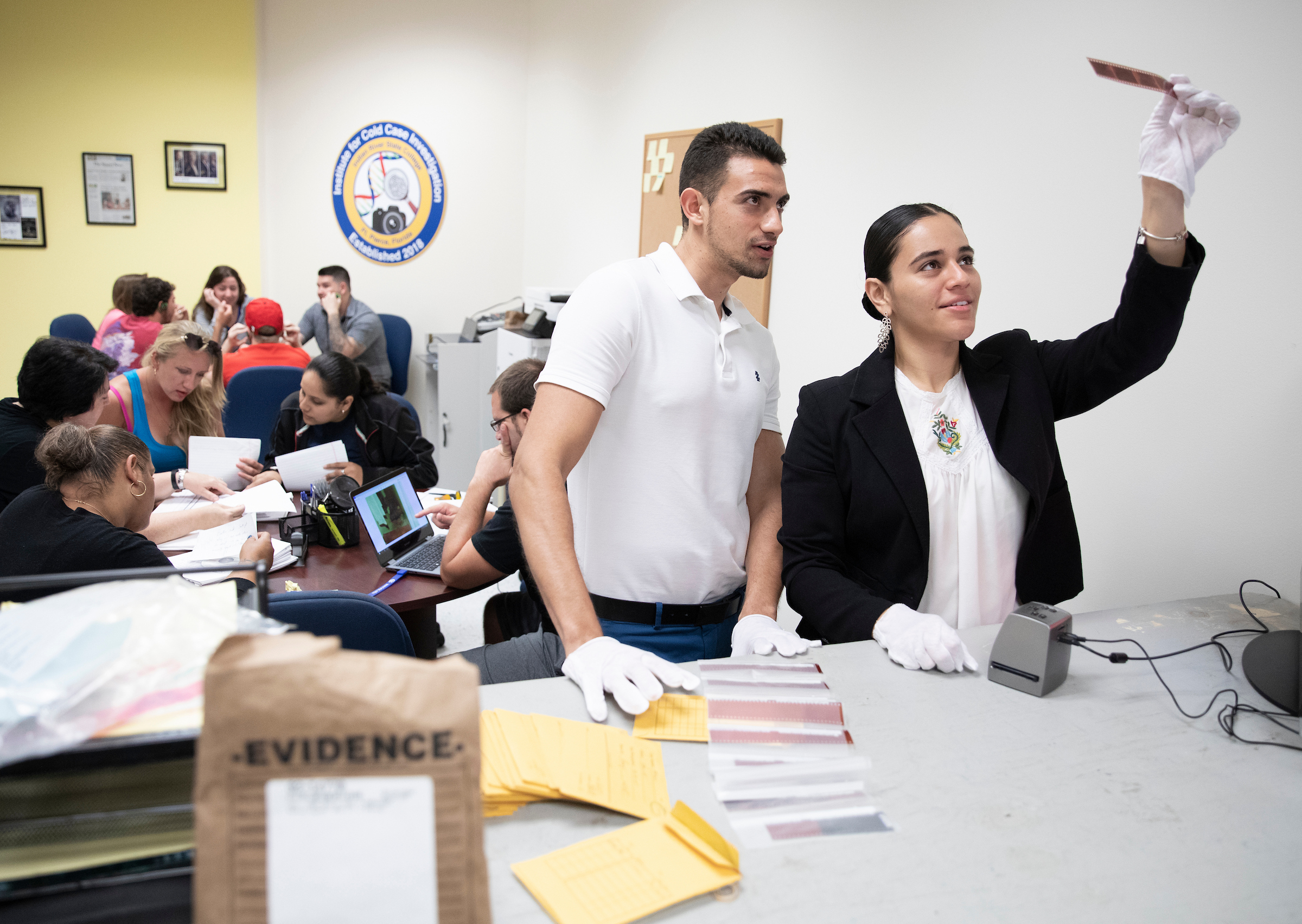
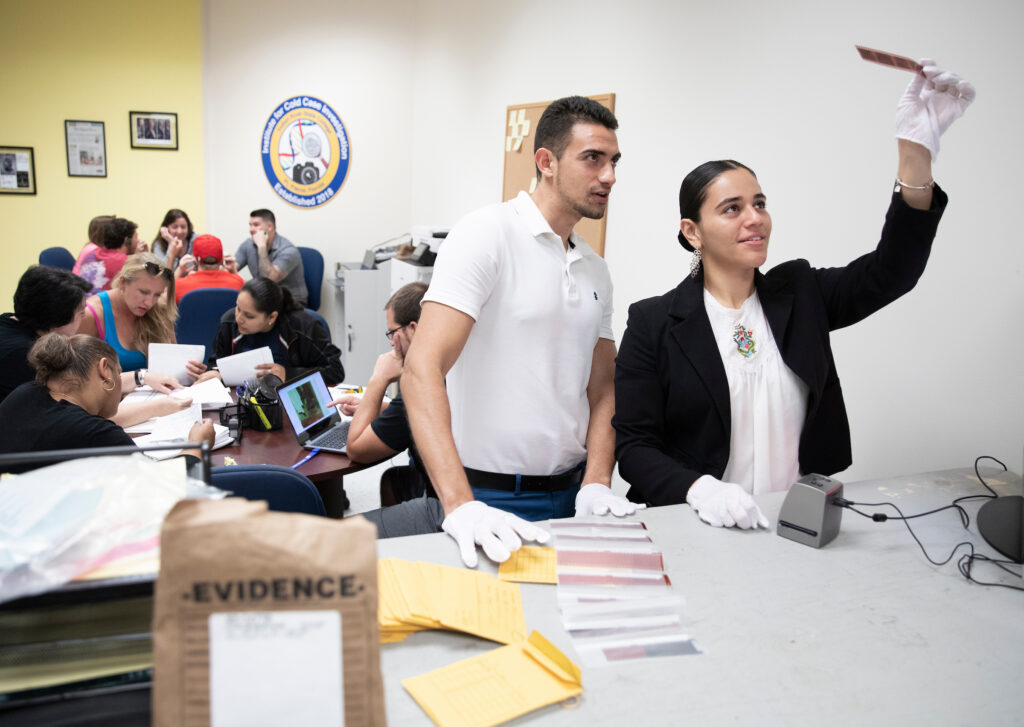
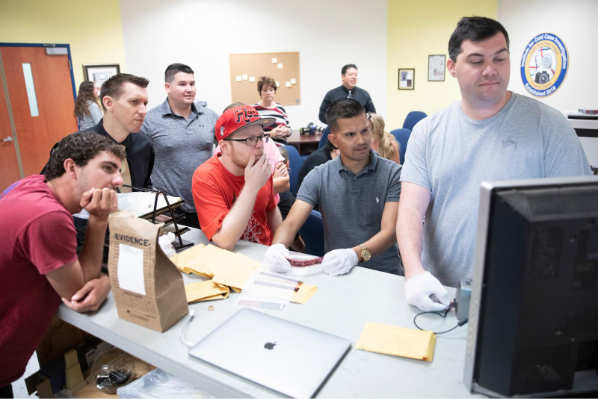
Digging into the details. Indian River State College cold case investigation students collaborate on unsolved mysteries, applying real forensic techniques to cases that need a fresh perspective.
You could be stuck on a simple fact for weeks, figure that out, and before you know it, you’re chasing another lead for a month,” Clay explained.
Clay is a student in the Institute for Cold Case Investigations at Indian River State College, the only program of its kind in the country. Founded in 2018 by Dr. Kimberlie Massnick, a forensic criminologist, the Institute gives students something most criminal justice programs can’t: real-world investigative experience working on actual unsolved cases with local sheriff’s offices.
When the trail goes cold, these students warm it back up. The cold case investigation course brings together analytical minds to reexamine unsolved cases using modern forensic methods and collaborative problem-solving.
And it’s working. To date, the Institute has solved, closed, or resolved five cases. Students have helped bring closure to grieving families, identified suspects, and contributed evidence that’s been presented to state attorneys. One case even caught the attention of Kelly Siegler, prosecutor and host of Oxygen’s Cold Justice, who worked alongside the Indian River County Sheriff’s Office, reviewing the suggestions and work done by students alongside the agency. Ms. Siegler then worked directly with the Sheriff’s Office to recommend and follow up on the case and pitch it to the State Attorney’s Office. (The Cold Justice episode aired on Oxygen on October 11, 2025).
A Program Born from a Simple Question
Dr. Massnick didn’t set out to revolutionize criminal justice education. She simply asked herself: what if students could do more than read about investigations—what if they could actually conduct them?
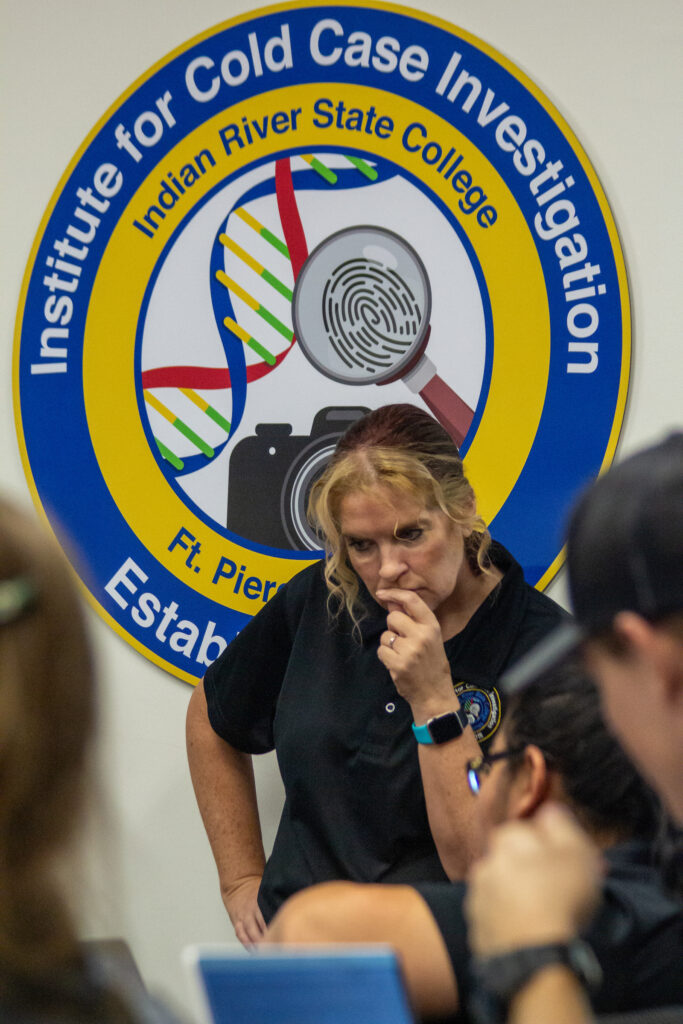
Dr. Kimberlie Massnick leads the Institute for Cold Case Investigation at Indian River State College
In an exclusive interview on IRSC Public Media’s RiverTalk, Dr. Massnick explained how the idea took shape. After speaking at a national conference about cold cases, she realized there was genuine public interest in the topic. She also noticed something troubling: when she asked audiences if they could name a victim of Ted Bundy, no one could. Everyone knew the killer. No one remembered the victims.
“At that moment, my entire life shifted,” she said. “This isn’t about the suspect, the person who did this. I’m going to change the narrative. We are going to talk about who is really important and who needs to be remembered.”
Massnick approached local sheriff’s offices with a bold pitch: let college students review cold case files. Surprisingly, one sheriff jumped at the opportunity. The college awarded her a grant, and the Institute was born.
The very first case they tackled? Solved in a single semester.
Learning from the Old School
The Institute operates as part of Indian River State College’s research methods course—a natural fit, since cold cases are essentially intensive case studies. Students apply everything they’ve learned across their criminal justice curriculum: critical thinking, criminological theory, investigative techniques, ethics, and evidence analysis.
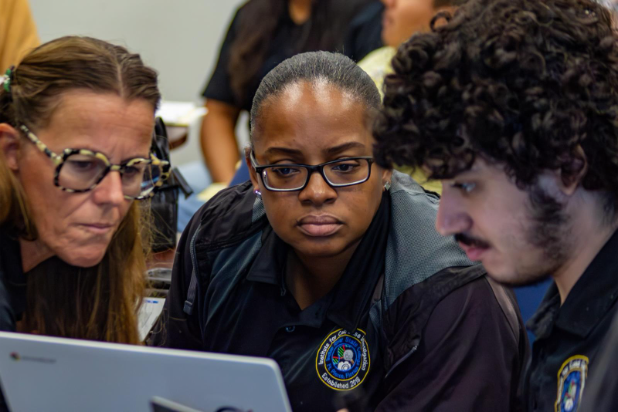
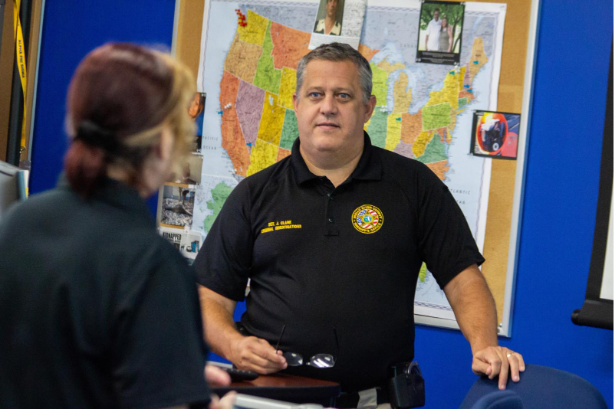
Students in the Institute for Cold Case Investigation at Indian River State College work with Indian River County Sheriff’s Office detectives
But what makes the program truly unique is the mentorship component and the actual sharing of the complete case file. Veteran detectives with 30 or 40 years of experience work directly with students, sharing insights that can’t be found in any textbook. These detectives are often the detectives originally assigned to the case or detectives currently with the agency.
Hannah MacDonald, a former student who appeared on RiverTalk alongside Dr. Massnick, recalled discussing with detectives how the work follows you home—how you start dreaming about cases, how the details infiltrate your subconscious. “You work so much with this stuff and you start thinking about it in your off time,” she said. The detectives taught her how to cope, how to decompress, and how not to become consumed by the darkness.
Chandler Sillaway, another Institute alum, remembers the moment a detective handed him a sticky note with two words written on it: probable cause. “I’m thinking, oh, this is serious,” Sillaway said. “Probable cause is what you need for an arrest. And that’s exactly what we were reaching for.”
Technology Meets Experience
Part of the program’s success comes from a simple fact: today’s students grew up with technology in their hands. What might have taken detectives days or weeks to uncover 20 or 30 years ago—tracking down public records, cross-referencing voter registrations, finding addresses—students can now do in minutes.
Future investigators at work. Students in the cold case investigation course analyze evidence and explore new angles on unsolved mysteries.
“These guys were born with computers in their hands,” Dr. Massnick said. “They can do things and think of things and go down rabbit holes that would have taken law enforcement a lot longer to do.”
But technology alone isn’t the answer. Dr. Massnick emphasizes that students must learn to “follow the evidence,” not their theories. As Sillaway put it: “It’s easy to go down a rabbit hole in your own theories. When you have detectives looking over your shoulder and you have Dr. Massnick looking over your shoulder as well, even though it’s hard to follow the evidence, you need to.”
The program also teaches students that investigations require collaboration. Some students discover they’re better suited for fieldwork; others thrive behind a computer organizing data and tracking leads. Both skill sets are essential.
Filling a Critical Gap
Louis Caprino, former FBI agent and now Dean of Public Service Education at Indian River State College, says Dr. Massnick’s work goes far beyond the classroom. She’s preparing students to succeed in law enforcement careers at every level—and at a critical moment.
Across the country, police departments are hemorrhaging experienced detectives. Since COVID-19, many veteran investigators have retired early, leaving departments struggling to fill the gap. The Institute helps address this crisis by producing graduates who can confidently answer the question every employer asks: Do you have experience?
Institute graduates have been hired by federal agencies like the Office of Special Investigations and the Department of State. Others have joined local law enforcement or started their own investigative businesses. Some, like Hannah MacDonald, are pursuing paralegal work specializing in criminal law. Chandler Sillaway is completing his master’s degree and pursuing federal investigations.
“They’re much more likely to be employed quicker,” Dr. Massnick said, “simply because they are able to answer that question, do you have any experience? And now they can say, not only do they have experience in investigation, but they can turn around and say, we’ve learned how to use this piece of equipment. We’ve learned how to bring you into the 21st century.”
More Than Just Solving Cases
For current students like Arianna Crespo and Cassidy Koch, the Institute has been transformative. Crespo says the program teaches you that “it could be anyone around you”—meaning detectives must always be willing to consider every possibility, no matter how uncomfortable.
Koch, inspired by crime shows and her mother’s interest in investigations, says she’s caught “the bug” for detective work and continues to stay involved even after completing the class.
But Dr. Massnick is clear: this work isn’t just about closing cases or launching careers. It’s about something deeper.
“When you see those crime scene photos, those are real people,” Chandler Sillaway said. “You have a person’s life in your hands and you’re trying to get justice for them.”
The Institute currently has two more cases moving forward. One has been presented to the state attorney’s office. Another involves a suspect who’s been identified but is out of state, making an arrest logistically complicated. And then there’s the case that could rewrite everything: five unsolved cases that appear to be connected to the same suspect.
If students successfully tie those cases together, they’ll be the only students in the country to have caught a serial killer.
“People don’t think it can happen in your backyard,” Dr. Massnick said.
At Indian River State College, students aren’t just learning about criminal justice. They’re practicing it. They’re bringing closure to families who’ve waited years—sometimes decades—for answers. They’re honoring victims whose names have been forgotten. And they’re proving that with the right training, mentorship, and determination, fresh eyes can solve even the coldest cases.
Learn more about the Institute for Cold Case Investigations and Indian River State College’s Criminal Justice programs at irsc.edu.
For media inquiries, email the Indian River State College Office of Public Information: pio@irsc.edu.
FORT PIERCE, Fla. (Oct. 15, 2025) – Indian River State College (“The River”) is hosting a series of virtual information sessions this fall to guide high school seniors and their families through The River’s Promise Program, which offers 100% tuition coverage for eligible Class of 2026 graduates.
The Promise 2026 Prep Sessions are designed to provide clear, step-by-step guidance to help students take full advantage of this transformative educational opportunity. These free virtual sessions will be offered in both English and Spanish to ensure all families have access to the information they need.
What Families Will Learn:
During these informational sessions, attendees will discover:
What the Promise Program is and who qualifies for 100% tuition coverage
The specific steps required to secure acceptance into the program
Key deadlines and next steps to stay on track for the 2026 academic year
Session Schedule:
Families can choose from multiple dates and language options:
Tuesday, Oct. 28 at 5:30 p.m. (English)
Thursday, Oct. 30 at 5:30 p.m. (Español)
Wednesday, Nov. 19 at 5:30 p.m. (English)
Monday, Dec. 15 at 5:30 p.m. (Español)
Tuesday, Dec. 16 at 5:30 p.m. (English)
How to Learn More:
Families are encouraged to visit irsc.edu/promise to review program requirements and confirm eligibility before attending a session. For questions or additional information, contact the Promise Program team at promise@irsc.edu.
Indian River State College anuncia Sesiones Promise 2026 para ayudar a estudiantes de preparatoria a obtener matrícula gratuita
FORT PIERCE, Fla. (15 de octubre de 2025) – Indian River State College (“The River”) ofrecerá una serie de sesiones informativas virtuales este otoño para guiar a estudiantes de último año de preparatoria y a sus familias a través del Programa Promise de The River, que brinda matrícula completamente gratuita a los graduados elegibles de la Clase de 2026.
Las Sesiones de Preparación Promise 2026 están diseñadas para ofrecer orientación clara, paso a paso, y ayudar a los estudiantes a aprovechar al máximo esta oportunidad educativa transformadora. Estas sesiones virtuales son gratuitas y se ofrecerán en inglés y en español para que todas las familias tengan acceso a la información que necesitan.
Lo que aprenderán las familias:
Durante estas sesiones informativas, los asistentes conocerán:
Qué es el Programa Promise y quiénes califican para recibir matrículagratuita
Los pasos necesarios para asegurar su lugar en el programa
Fechas importantes y próximos pasos para mantenerse al día rumbo al añoacadémico 2026
Calendario de sesiones:
Las familias pueden escoger entre varias fechas y opciones de idioma:
Martes, 28 de octubre, a las 5:30 p.m. (inglés)
Jueves, 30 de octubre, a las 5:30 p.m. (español)
Miércoles, 19 de noviembre, a las 5:30 p.m. (inglés)
Lunes, 15 de diciembre, a las 5:30 p.m. (español)
Martes, 16 de diciembre, a las 5:30 p.m. (inglés)
Cómo obtener más información:
Se invita a las familias a visitar irsc.edu/admissions/promise/ para revisar los requisitos del programa y confirmar su elegibilidad antes de asistir a una sesión. Para preguntas o información adicional, comuníquese con el equipo del Programa Promise al correo promise@irsc.edu.
¡Suscríbase para mantenerse informado sobre Promise 2026!
DirectConnect to UCF® to offer streamlined transfers from The River to UCF
FORT PIERCE, Fla. (September 29, 2025) — Indian River State College has partnered with the University of Central Florida to offer DirectConnect to UCF®. This nationally recognized program provides eligible students with guaranteed admission to UCF. All Indian River State College students and alums who obtain, or have previously obtained, an Associate in Arts (A.A.) or Associate in Science (A.S.) degree qualify for DirectConnect to UCF®.
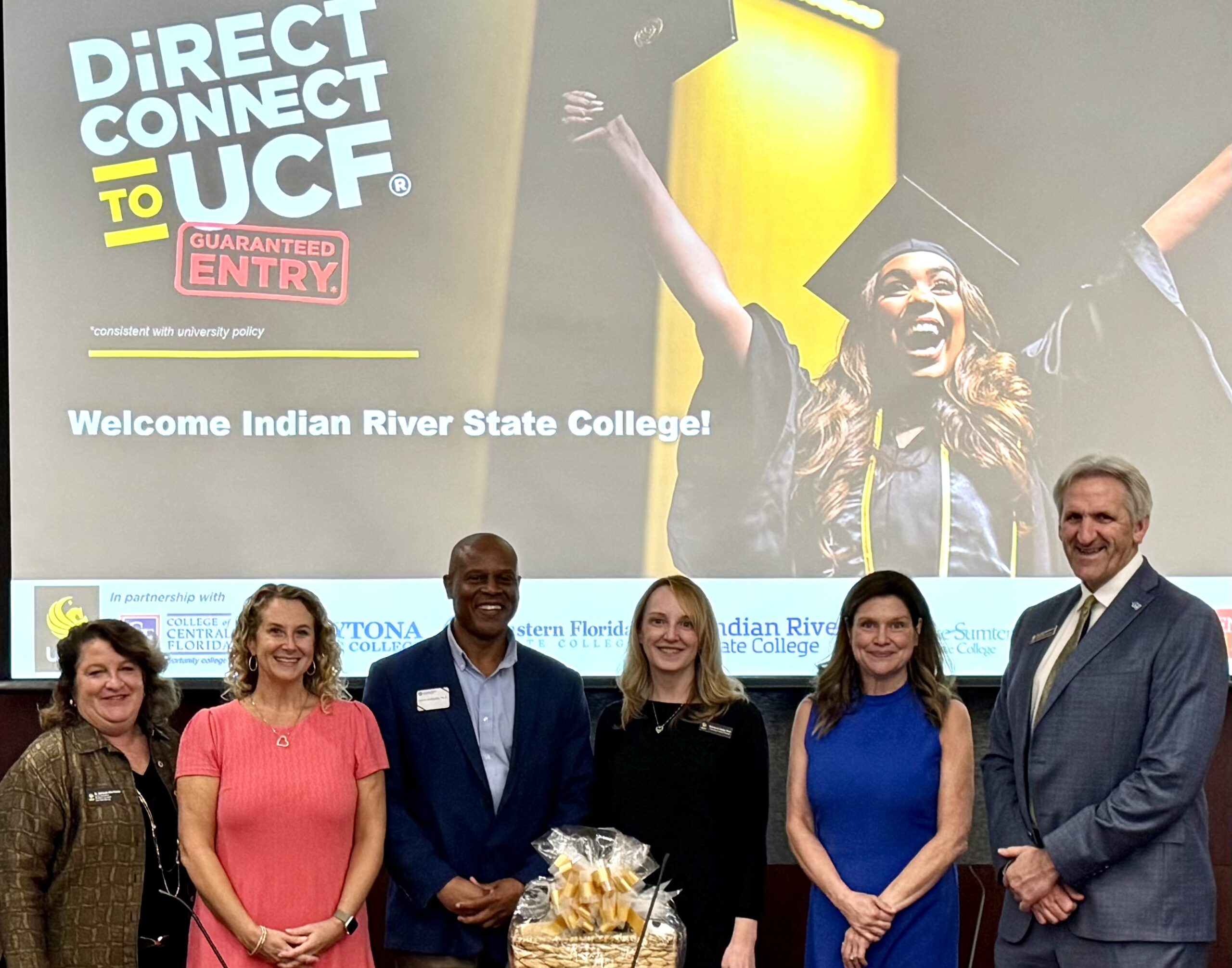
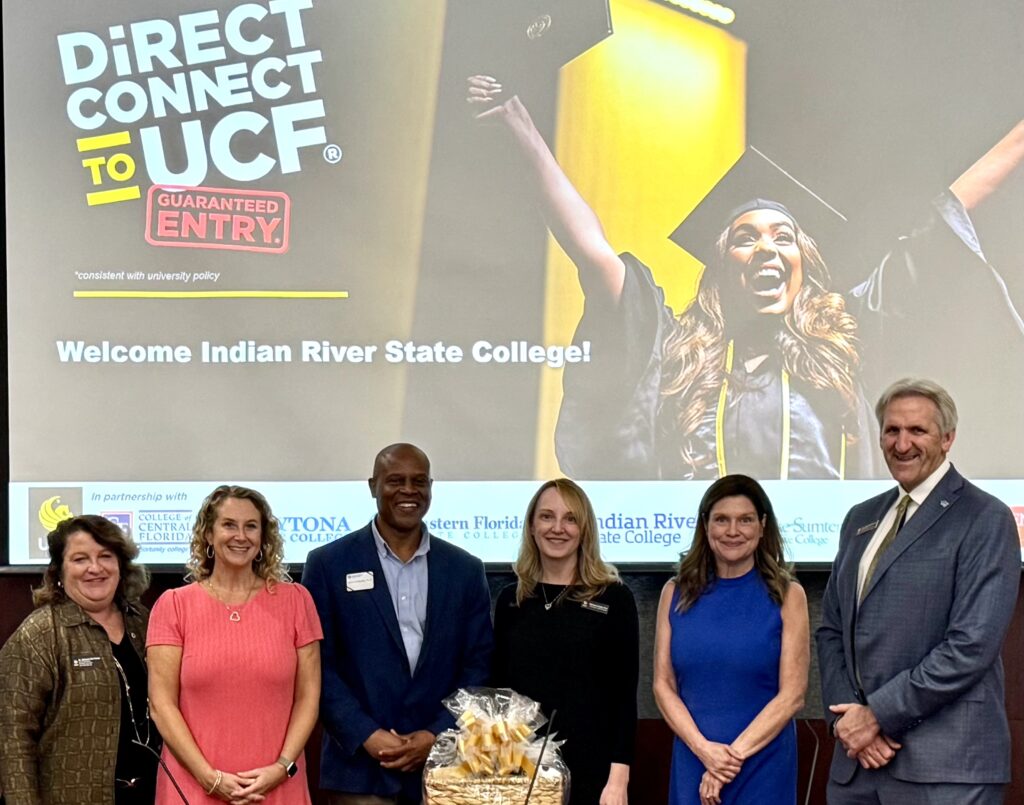
Indian River State College and University of Central Florida representatives at the launch celebration of DirectConnect to UCF: Adrienne Frame, Elizabeth Gaskin, Dr. Calvin Williams, Kimberly Hardy, Dr. Heather J. Belmont, and John Buckwalter
“This partnership represents a transformative opportunity for students across the Treasure Coast region,” said Dr. Timothy E. Moore, president of Indian River State College. “Through DirectConnect to UCF®, Indian River State College is providing students with another pathway to a four-year degree and expanded career opportunities with the resources and support they need to succeed from Day One.”
DirectConnect to UCF® offers an accelerated admission pathway to the University of Central Florida, providing students with dedicated support through a personal success coach and transfer assistance from UCF Success Coaches. This program is designed to help students complete their degree in a shorter timeframe while offering the convenience of studying close to home at Indian River State College, making higher education more accessible and efficient for local students.
“DirectConnect to UCF has already helped nearly 80,000 students turn their aspirations into achievement, and this new partnership with Indian River State College extends that promise to even more learners from across the Treasure Coast,” said UCF President Alexander N. Cartwright. “Together, we are building new pathways to opportunity that will transform lives and strengthen Florida’s future.”
“DirectConnect to UCF® aligns perfectly with our commitment to student success and academic excellence,” said Dr. Heather Belmont, provost of Indian River State College. “This partnership ensures our students receive seamless transfer credit, dedicated academic support, and a proven framework for degree completion.”
DirectConnect to UCF®, which marks its 20th anniversary this November, has helped more than 80,000 students earn UCF degrees. The award-winning initiative has received national recognition, including the National Association of Branch Campus Administrators’ 2020 Innovation Award for its groundbreaking success coaching model.
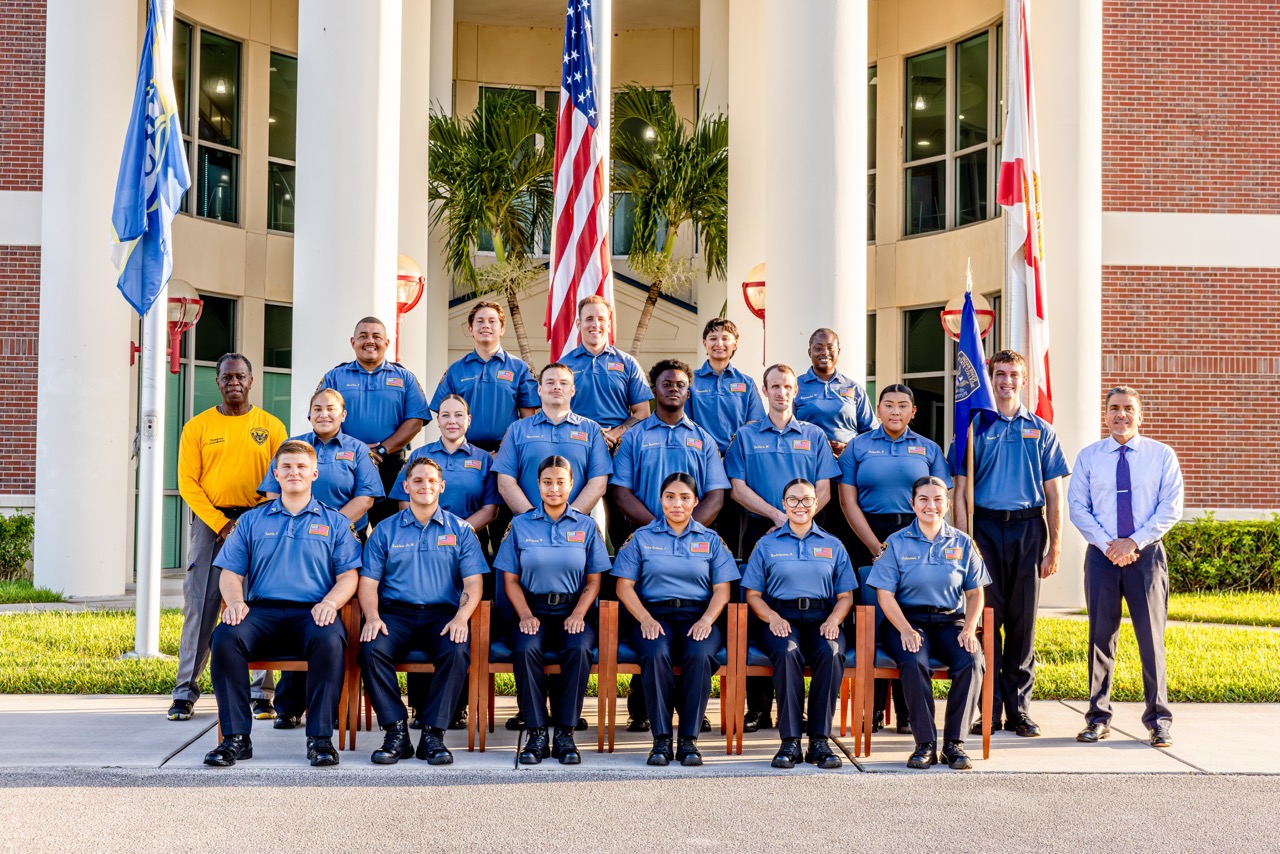
Corrections Academy Class #178 graduates celebrate their completion of the rigorous 420-hour Basic Recruit Training Program, marking the beginning of their careers as correctional officers in state and federal facilities.
FORT PIERCE, Fla., (Sept. 19, 2025) – Indian River State College’s Criminal Justice Institute successfully graduated two distinguished classes from its Public Service Academy: Law Enforcement Academy Class #181 and Corrections Academy Class #178. These ceremonies celebrated the completion of intensive training programs that prepared graduates for critical roles in Florida’s criminal justice system.
Corrections Academy Class #178 Graduation
Corrections Academy Class #178 celebrated its achievement on Friday, Sept. 19, 2025, at Indian River State College. The ceremony recognized graduates who completed one of the most comprehensive corrections training programs in the state.
Each graduate successfully completed the Basic Recruit Training Program (Corrections), which included over 420 hours of classroom instruction and hands-on practical exercises. This comprehensive training provided them with the skills needed to effectively work with inmates while exercising professionalism. Their lessons on how to effectively communicate, interact with, and respond to a range of populations will help ensure their safety and the safety of others.
The curriculum included inmate supervision and custody procedures, use of force protocols and legal standards, defensive tactics and officer safety, communication and de-escalation skills, emergency response procedures, report writing and documentation, ethics and professional standards, legal standards governing corrections, facility security protocols, and contraband detection and searches.
“I am incredibly proud of the individuals who graduated, as they demonstrated the discipline, responsibility, and professionalism required to serve in one of the most demanding roles in the criminal justice system,” noted Indian River State College President Timothy E. Moore. “This represented a critical step in building a strong and capable corrections workforce that will serve our communities with dedication and integrity.”
Corrections Academy Class #178 graduates are Elizabeth Alvarez, Quinn Bostic, Frankz Davila, Travis Garrison, Alicia Hilario, Indiony Jean-Baptiste, Vanessa Johnson, Hannah Newsome, Marc Rediker, Alani Rodriguez, Sherlyn Salgado, Monique Samuels, Vincent Saputo, Isabella Saucedo, Matthew Sellers, Jacob Smith, Joseline Uribe-Godinez, and Dominic Witherow.
Corrections Academy graduates are now qualified for positions including correctional officers in state and federal facilities, juvenile detention officers, probation and parole officers (with additional certification), court security officers, transportation officers, private corrections facility staff, and rehabilitation program coordinators.
Law Enforcement Academy Class #181 Graduation
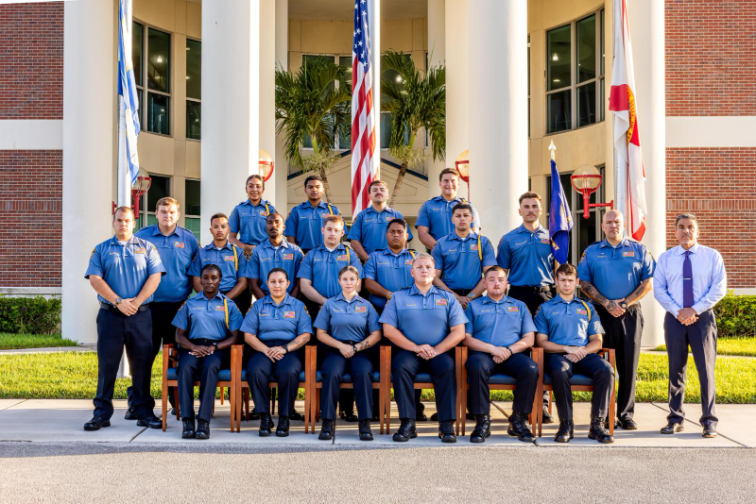
Law Enforcement Academy Class #181 graduated Sept. 3, 2025. The ceremony was attended by friends, family, community leaders, and media who gathered to honor these new guardians of public safety.
Law Enforcement Academy Class #181 graduates celebrate their completion of the rigorous 770-hour Florida Basic Recruit Training Program, marking the beginning of their careers in law enforcement and public service.
Graduates successfully completed a demanding 770-hour Florida Basic Recruit Training Program that encompassed comprehensive instruction across multiple critical areas: criminal law and legal procedures, firearms training and marksmanship, defensive tactics and officer safety, emergency vehicle operations, de-escalation techniques and conflict resolution, community policing strategies, mental health awareness and crisis intervention, cultural competency training, report writing and documentation, and physical fitness and conditioning.
LE 181 Graduates are Jax Boris, Matthew Chandool, Cheyenne Dechert, Daniel Deluck, Zachary Dominguez, Julien Eason, Kenya Fils-Aime, Rosemary Gil, Trevor Goodrich, Evan Goforth, Joshua Hengstler, Evan Kicker, Austin Miller, Christyan Murray, Rodolfo Nazco, Aaliyah Rodriguez, Bryan Romero Gonzales, Brendan Sposato, and Leonardo Vargas.
Graduates are now qualified to pursue careers as municipal police officers, county sheriff’s deputies, state law enforcement officers, federal law enforcement agents (with additional training), campus security officers, private security supervisors, and loss prevention specialists.
“This program was both mentally and physically demanding, and our graduates showed extraordinary commitment, discipline, and resilience throughout this process,” said Indian River State College Public Service Academy Dean Lou Caprino. “We were proud to welcome them as guardians of public safety who are prepared to serve with integrity and professionalism.”
Prospective students can explore programs, meet faculty, and discover career pathways at open houses throughout the academic year
FORT PIERCE, Fla. (Sept. 12, 2025) — Indian River State College (“The River”) is welcoming prospective students across the Treasure Coast to a series of open house events during the 2025–26 academic year. From nursing to business, public service to science and education, these events showcase the wide horizon of opportunities available at The River year-round.
Upcoming open house events:
Sep. 16, 2025 – Nursing (Pruitt Campus)
Oct. 2, 2025 – Business and Workforce
Oct. 7, 2025 – Public Service
Oct. 8, 2025 – Math, Science, and Education
Feb. 9, 2026 – Health Science
March 2026 – Math, Science, and Education
April 9, 2026 – Nursing
April 14, 2026 – Public Service
April 16, 2026 – Business and Workforce
Prospective students who attend will gain a firsthand look at how Indian River State College programs connect directly to in-demand careers across the Treasure Coast. They will leave with a stronger sense of the skills they will learn, the professions those skills lead to, and how The River provides an affordable and effective route to their goals.
Those who attend an open house see how Indian River State College students benefit from hands-on experience in state-of-the-art labs, direct connections to industry leaders, and opportunities to apply classroom learning in real-world settings. These experiences ensure graduates leave with the confidence, skills, and professional network needed to succeed immediately in their chosen careers.
For details on open house events, visit https://connect.irsc.edu/?category=open-house. For more information about how Indian River State College can help students take the next step toward their future, visit www.irsc.edu for locations and program offerings.
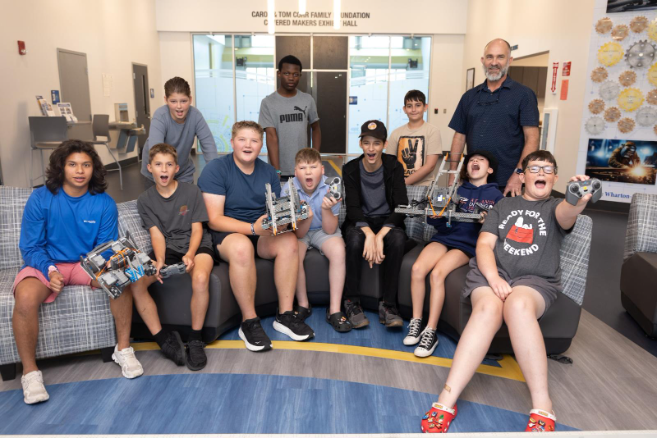
FORT PIERCE, Fla. (September 9, 2025) — Indian River State College (“The River”) is excited to announce the launch of its comprehensive Robotics Program designed for young learners ages 10-14. The program, at the College’s Eastman Advanced Workforce Training Complex, offers students hands-on experience building and programming robots using industry-standard VEX IQ kits, providing an engaging introduction to STEM education.
Young engineers get hands-on experience building and programming robots at The River’s Youth Robotics Program and Camps
Located at 3209 Virginia Avenue in Fort Pierce, the program features three skill levels to accommodate students at different stages of their robotics journey:
Program Structure:
Beginner ($250) – Our beginner sessions are the perfect introduction to robotics. Students will learn the basics of building and programming robots while exploring how mechanical and coding systems work together. No prior experience is needed—just curiosity and creativity! Two sessions available: October 4, 5, 11 & 12, and October 18, 19, 25 & 26
Intermediate ($150) – Our intermediate sessions are designed for students who already have a foundation in robotics. Students will take their skills to the next level with more complex robot builds, advanced programming concepts, and problem-solving challenges that encourage teamwork and creativity. Two sessions available: November 8 & 9, and November 22 & 23
Advanced ($150) – Our advanced session is for students ready to take their robotics skills to the highest level. In this session, students will tackle complex engineering builds, explore advanced coding strategies, and work through real-world style robotics challenges that strengthen problem-solving, teamwork, and innovation. Session on December 6 & 7
Classes run Saturdays from 9 a.m. – 5 p.m. and Sundays from 10 a.m. – 3 p.m., allowing students to learn at their own pace while exploring fundamental STEM concepts in an interactive, fun environment.
The VEX IQ platform is specifically designed for younger students, featuring snap-together pieces that make robot construction accessible while still teaching real engineering principles. Students will learn to program their robots to complete various challenges and tasks, fostering both creativity and logical thinking.
We use cookies to improve your experience on our site. By using our site, you consent to cookies.
This website uses cookies
Websites store cookies to enhance functionality and personalise your experience. You can manage your preferences, but blocking some cookies may impact site performance and services.
Essential cookies enable basic functions and are necessary for the proper function of the website.
Name
Description
Duration
Cookie Preferences
This cookie is used to store the user's cookie consent preferences.
30 days
Google Tag Manager simplifies the management of marketing tags on your website without code changes.
Name
Description
Duration
cookiePreferences
Registers cookie preferences of a user
2 years
td
Registers statistical data on users' behaviour on the website. Used for internal analytics by the website operator.
session
These cookies are used for managing login functionality on this website.
Name
Description
Duration
wordpress_logged_in
Used to store logged-in users.
Persistent
wordpress_sec
Used to track the user across multiple sessions.
15 days
wordpress_test_cookie
Used to determine if cookies are enabled.
Session
Statistics cookies collect information anonymously. This information helps us understand how visitors use our website.
Name
Description
Duration
_ga_4K1MVK713S
Stores data related to the current users session, including its start time, engagement flags, and total session count.
400 days
_ga
Stores a pseudo anonymous browser (client) ID that is used to help calculate unique users to the website.
400 days
Marketing cookies are used to follow visitors to websites. The intention is to show ads that are relevant and engaging to the individual user.
Name
Description
Duration
_gcl_gb
Stores the most recent "wbraid" (advertising click id) set from an interaction with an ad on Googles advertising network(s). This data is used to measure advertising performance.
90 days
_gcl_ag
Stores the most recent "gbraid" (advertising click id) set from an interaction with an ad on Googles advertising network(s). This data is used to measure advertising performance.
90 days
_gcl_aw
Stores the most recent "gclid" (advertising click id) set from an interaction with an ad on Googles advertising network(s). This data is used to measure advertising performance.
90 days
Name
Description
Duration
_fbc
Stores the most recent "fbclid" (advertising click id) set from an interaction with an ad on Facebook or Instagram. This data is used to measure advertising performance.
90 days
_fbp
Stores a pseudo anonymous browser (client) ID that is used to help calculate unique users to the website.